
The Bottle That Changed My Life
My name is Adam Rivers, and I’m thirty-four years old. For the last six years, I’ve been raising my daughter Lily on my own, ever since my wife Sarah was killed in a car accident that shattered our lives in an instant. What I’m about to share is the story of how a simple act of kindness—giving away a bottle of water—cost me my job, left me standing in the cold with only my daughter’s embrace, and uncovered a legacy I never imagined existed.
It began on a gray Tuesday morning in November, under the flickering warehouse lights that cast their usual jagged shadows across the concrete floor I had walked for over a decade.
Where It All Started
I had worked at Patterson Logistics since I was twenty-two. Back then, Lily was still a toddler and Sarah was alive, kissing us both goodbye each morning. The work was demanding but straightforward—loading trucks, checking manifests, making sure shipments moved on time. It wasn’t glamorous, but it was steady, and steady was exactly what Lily and I needed after losing Sarah.
That Tuesday morning felt routine. I clocked in at six sharp, grabbed my clipboard, and headed to the dock. The warehouse was alive with the hum of machines, and in the distance, I could hear Tommy Rodriguez firing up the first forklift of the day.
Halfway through checking inventory, I noticed something unusual in the far corner near an emergency exit that was almost never used. A figure slumped against a stack of shipping containers.
As I moved closer, I saw a man—clearly a biker. His leather jacket was ripped and bloodstained, his boots scraped and worn. One eye was swollen shut, and dried blood streaked down the side of his face. Despite his injuries, there was something about his posture—upright, unbroken—that spoke of resilience.
I glanced upward. That corner was a known blind spot in our camera coverage. He hadn’t landed there by accident; either luck or experience had guided him.
Without thinking about rules or repercussions, I pulled my thermos and a bottle of water from my lunch bag. He took them with trembling hands, gave me a brief but sincere nod, and disappeared through the exit just as quickly as he had appeared.
It was over in less than a minute. I returned to my clipboard, not realizing that even kindness leaves a trace in a place ruled by cameras and protocols.
When It All Fell Apart
Three days later, I walked into work wearing my favorite baseball cap—stitched by Lily with uneven red thread spelling out “My Hero.” It was crooked and imperfect, but it meant everything.
Before I could even reach the dock, my manager, Todd Coleman, appeared with two security guards in tow. Todd had a way of carrying himself like he was above the rest of us, always reminding people that he’d gone to business school.
“Adam, we need to talk,” he said, his voice clipped and formal.
In the break room, he opened a file folder stuffed with papers. “You were seen on security footage assisting an unauthorized individual who gained illegal access to company property. You gave him aid, failed to alert security, and allowed him to leave. That’s a major violation.”
I tried to explain. “He was hurt. I gave him coffee and water. That’s it.”
Todd’s expression didn’t shift. “Your job isn’t to play Good Samaritan. You could have endangered the entire facility. This is gross negligence.”
The guards moved in closer. The decision was final.
“Effective immediately, you’re terminated. Clear out your locker. You will not receive a reference.”
Minutes later, I was outside the gate, clutching a cardboard box filled with work gloves, a mug Lily had given me for Father’s Day, and a framed photo of Sarah. The November wind stung my face as I sat on the curb, wondering how I was supposed to explain to my daughter that I’d lost my job for giving a stranger a drink of water.
Facing Lily
That night, rain dripping from my jacket, I walked into our small kitchen. Lily was coloring at the table, her purple crayon in hand. Her eyes lifted to me, filled with the quiet wisdom only children seem to have.
“Daddy, are you sick?” she asked.
I shook my head. “Just tired, sweetheart.”
Her little frown deepened. “Did something bad happen?”
I forced a smile. “Nothing bad. Just a normal day.”
But she saw through me. After a pause, she whispered, “Daddy, did we get fired?”
The way she said “we” broke me. Since Sarah’s death, Lily had instinctively known we were a team—that my struggles were her struggles. I nodded, unable to speak.
She climbed into my arms, hugging me tightly. “It’s okay, Daddy. You’re still my hero. Heroes have bad days too.”
Her words carried more comfort than anything I could have told myself.
The Roar in the Night
After Lily was asleep, I sat at the kitchen table with a stack of bills, trying to calculate how long we could last without my paycheck. Six weeks at most. My mind was spinning when I heard it—a deep rumble growing louder.
Motorcycles. Dozens of them.
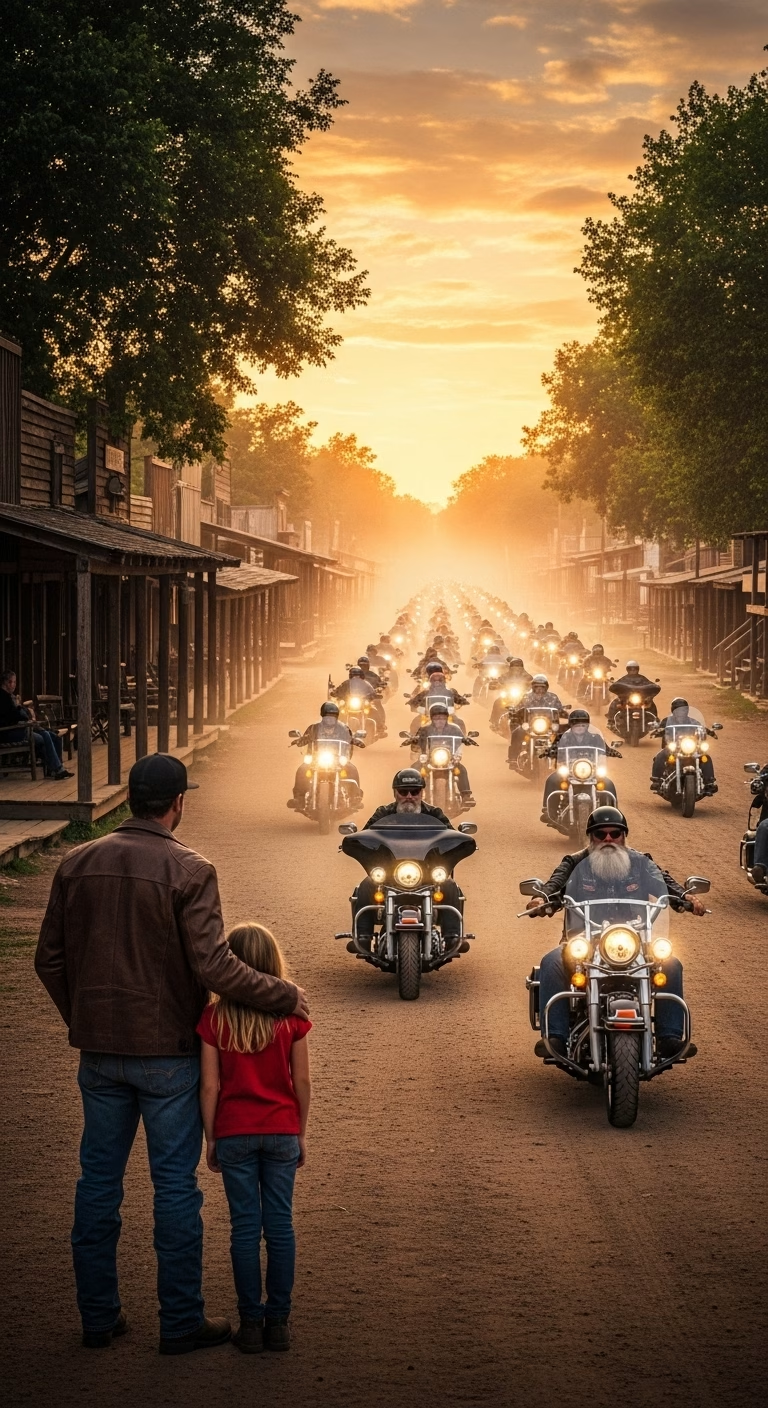
I rushed to the window. The street outside filled with bikes—forty or more lined up in gleaming rows under the streetlights. The riders dismounted in practiced silence, their leather jackets marked with patches, their presence both intimidating and strangely orderly.
I stepped onto the porch, instinctively shielding Lily from view. That’s when I recognized one of them—the man I had helped in the warehouse. His injuries were gone, his jacket new. He nodded at me, then stepped aside as another man approached.
Tall, lean, silver-bearded, with the kind of weathered hands that told stories of work and time. His presence commanded attention.
“You helped one of ours,” he said simply.
“I just gave him some water. He was hurt,” I answered.
The older man’s smile was faint but warm. “Exactly. And nobody does that anymore—at least not without expecting something back.”
Behind me, Lily’s voice broke the tension. “Daddy, are they superheroes?”
The man chuckled softly. “No, kid. Just people who don’t forget when someone shows kindness to family.”
The Family Secret
The man introduced himself as Marcus. He handed me an old brass key. “Come with us. There’s something that belongs to you—something that should have been yours years ago.”
Curiosity overcame caution. Lily and I joined Marcus in his truck as the convoy roared to life. We drove across town, into a district lined with auto shops and garages, until we stopped at a freshly painted building with a new sign: Rivers Customs – Motorcycle Restoration and Repair.
I froze. “I don’t understand. I don’t have the money or the knowledge for this.”
The biker I’d helped—his name was Ridge—rested a hand on my shoulder. “Your father, Russell Rivers, was one of us. He once saved my brother’s life. This shop was meant for you. We’ve been fixing it up, waiting until the time was right.”
My father. My mother had always said he was a truck driver who died in an accident. She never told me about this.
Marcus must have read my confusion. “She wanted to protect you, Adam. She thought this world was dangerous. But some legacies can’t stay buried.”
Inside, the garage was immaculate. Hydraulic lifts, tools, workbenches—everything a mechanic could dream of. In the center stood a gleaming Harley, restored to perfection.
“This was your dad’s bike,” Ridge said. “We rebuilt it, piece by piece. It’s exactly how he rode it.”
I approached it slowly, in awe.
“This isn’t charity,” Marcus added firmly. “It’s your inheritance. Your father earned it. Now it’s your turn.”
A New Beginning
In the weeks that followed, Lily and I became fixtures at the shop. She did homework at a little desk they set up for her, while I learned the trade from masters. Marcus could read an engine like a book. Ridge knew electrical systems inside out. Tommy, quiet and tattooed, transformed scarred metal into art.
They taught me that bikes speak in their own language—through sound, vibration, even smell. Repairing them wasn’t just mechanical; it was about honoring their story.
Lily, ever curious, declared: “Every motorcycle has a story, and we help them tell it better.” She filled a notebook with “bike stories,” documenting each repair in her careful handwriting. The men started calling her “Little Rivers,” and in their company, we found the family we’d been missing.
The First Job
Our first customer came in December. Serena Martinez, a widow, brought her late husband’s 1995 Sportster. It had sat untouched since his funeral. She wanted to ride it—to keep a part of him alive.
The bike needed everything—tires, brakes, carburetor work, electrical repairs. I spent three days on it, guided by Marcus and Ridge, treating every detail with reverence.
When Serena returned, she touched the chrome like it was sacred. The engine purred to life as if welcoming her.
“How much?” she asked, reaching for her purse.
“Not this time,” I told her. “This one’s on us.”
Her eyes welled with tears as she hugged me. “You gave me my husband back.”
Word spread quickly. Soon, bikes from across the community filled our bays. Some jobs paid full, others came with trades or promises. But I’d learned something: the greatest payment wasn’t money—it was helping someone restore what mattered most.
Crafting a Name
As winter gave way to spring, Rivers Customs began earning a reputation that reached beyond the biker circles. Riders who had been turned away from dealerships because their bikes were too old, too unique, or too customized started showing up at our doors.
I realized I hadn’t just inherited my father’s shop—I had also inherited his instincts. It wasn’t just about tools or manuals; it was an almost natural way of understanding machines. Fixing motorcycles that others thought were beyond saving became my quiet joy—there was something profoundly fulfilling about bringing a bike back from the edge and returning it to life.
Lily’s role grew right alongside mine. She had a way with people, greeting customers warmly and explaining, in her own words, what we were doing for their bikes. She made everyone feel like their motorcycle wasn’t just another job—it was part of a story worth telling.
On her own initiative, she became our “marketing team,” drawing flyers and even creating a logo. Flames and a little figure—clearly meant to be her—adorned the design. Beneath it, in her neat handwriting, she added a tagline: “Rivers Customs—where broken things become beautiful again.”
A Visit to the Classroom
Six months after I lost my warehouse job, something unexpected happened. Lily’s teacher, Mrs. Henderson, invited me to speak at Career Day. The idea of standing in front of a room full of third-graders made me uneasy—what could a motorcycle mechanic possibly say to children who dreamed of being firefighters or doctors?
But Lily’s excitement won me over. To her, it wasn’t about mechanics. It was about showing her classmates what her dad did—and why it mattered.
When I walked into the classroom, I noticed the walls covered in colorful posters of different professions. Near the teacher’s desk hung Lily’s drawing: a man in work clothes fixing a motorcycle, with a little girl standing close by. At the bottom she had written, “My dad fixes things that other people give up on.”
Looking at her proud smile, I understood the truth—I wasn’t just repairing machines. I was living proof that broken things could be restored, that setbacks didn’t define you, and that sometimes the wrong turn takes you to the right place.
“What I really do,” I told those kids, “is listen to motorcycles, figure out what they need, and help them run like they should. But the most important part of my job isn’t the machines—it’s the people who love them.”
A Holiday Surprise
That December, exactly a year after everything changed, the roar of motorcycles filled our street again. Only this time, the riders wore Santa hats, with tinsel wrapped around handlebars. The same group that had once seemed intimidating now looked like a holiday parade.
Ridge carried a big wrapped box to our door, smiling wider than I’d ever seen. Inside was a custom leather jacket, made just for Lily, with “Little Rivers” stitched proudly across the front. Underneath lay a child-sized helmet, painted with flames—the same kind she doodled in her sketchbooks.
“You’re one of us now,” Ridge told her, crouching down to meet her eyes.
Lily squealed with joy, hugging him before running from bike to bike, asking questions, touching chrome, and laughing as they let her sit in their saddles. Watching her surrounded by that brotherhood—men who looked tough but treated her with the gentleness of uncles—I realized something important. We hadn’t just gained a business. We had gained a family.
Expanding Horizons
By the following spring, Rivers Customs had grown faster than I could have imagined. We were booked weeks out, and the custom fabrication work that started as side projects had become a full part of our income. Marcus suggested expanding into the neighboring building, which had just become available.
The new space gave us room to specialize—paint and bodywork in one area, electrical diagnostics in another, and a section dedicated to engine rebuilding. We even hired two young mechanics Marcus had once mentored, bringing them into the fold.
Lily, ever the visionary, proposed setting up a “customer lounge.” She decorated it herself with magazines, coffee, and photo albums showing our restoration projects. Customers could sit comfortably while we worked, and the albums told our story better than any advertisement could.
The shop wasn’t just providing for us financially anymore—it was helping the community. We gave jobs to people who needed a chance, and we kept motorcycles alive for riders who saw them as more than just transportation.
Ripples of Kindness
The story of Rivers Customs spread farther than I ever expected. Motorcycle magazines ran features on us, telling the tale of how a bottle of water had cost me a warehouse job but started something bigger. Social media posts about our work brought customers from hours away.
But we never chased publicity. What mattered wasn’t attention—it was the work itself, the small wins that came from fixing something meaningful to someone.
One man, David, brought in his sister’s bike. She had lost her job and was relying on that motorcycle to get to interviews. But the bike had broken down, and she couldn’t afford dealership repairs.
We spent two days fixing it—rewiring the electrical, replacing brakes, making it roadworthy again. When David asked about the bill, I only charged for parts.
“Labor’s free,” I told him, “when it helps someone get back on their feet.”
Weeks later, his sister visited us with a thank-you card. She’d landed a job, and she credited the repair for making it possible. Lily proudly taped the card to the wall alongside the growing collection of handwritten notes from grateful customers.
A Philosophy of Repair
Over time, I came to understand that Rivers Customs wasn’t just a shop—it was a philosophy. We weren’t only repairing motorcycles. We were restoring connections, honoring stories, and proving that second chances are real.
Each bike that rolled through our doors carried history. Veterans working through trauma. Widows holding on to memories. Young riders learning to build something of their own. Our job wasn’t simply mechanical—it was deeply human.
Lily captured it best when she redesigned our logo again. Beneath “Rivers Customs” she added three simple words: “Built on Kindness.”
When people asked, I told them about the water bottle—the act of compassion that cost me one life but gave me another.
“Kindness,” I’d explain, “isn’t weakness. It’s believing that everyone deserves help when they need it. And if you do that, good things follow.”
Coming Full Circle
Two years after losing my warehouse job, the past caught up with me. My old manager, Todd Coleman, called. His voice was careful, almost apologetic. He wanted Rivers Customs to restore his father’s vintage Honda.
When he arrived, he seemed smaller, humbled. He explained how much the bike meant to him—how his father had ridden it for years until illness forced him to stop. It was one of the last connections he had to him.
I worked on that Honda for weeks, treating it like every other restoration—with patience, care, and respect for the story behind it. When Todd returned, the engine roared to life with a smoothness that brought tears to his eyes.
“How much do I owe you?” he asked.
I remembered that day when he fired me, when his decision left Lily and me out in the cold. But then I thought about what Lily always said—about broken things becoming beautiful again.
“Five hundred,” I said, far less than the job was worth.
He wrote the check with trembling hands. Before leaving, he turned back, his voice unsteady. “Adam, I’m sorry. I punished you for being compassionate. That was wrong.”
I nodded. “People make mistakes. What matters is what they learn.”
He rode away on his father’s bike, and though I never saw him again, his words stayed with me. It wasn’t about changing the past—it was about proving that kindness had been the right choice all along.
Carrying the Legacy
Today, Rivers Customs employs six mechanics, with customers traveling from a dozen states just to have their bikes repaired here. We have a waiting list for custom builds, and our reputation continues to grow.
Lily, now eleven, can diagnose a bike just by listening to it. She manages our online presence, sharing photos and stories that showcase not just our work but the people behind it.
Marcus, even in his seventies, still teaches. Ridge has become my partner, and Tommy mentors newcomers in paint and bodywork. They’re more than colleagues—they’re family. And Lily has shown them all that kindness isn’t something soft. It’s strength.
The water bottle itself is long gone, but its legacy remains in every bike we repair, every person we help, and every choice we make to put compassion before convenience.
What started as a single act of decency turned into a life I never imagined. Not just a business, but a family. Not just repairs, but proof that kindness ripples outward, changing everything it touches.
The thunder of engines that night didn’t just bring bikers to my door. It brought me home.
Trending Right Now:
- My Mother-in-Law Tried On My Wedding Dress and Destroyed It — So I Made Her Regret It Publicly
- He Cheated. She Laughed. I Served Them Both a Slideshow of Karma
- “I Overheard My Husband and Our Neighbor’s Daughter — So I Came Up With a Plan She Never Saw Coming”
- He Couldn’t Move, But He Knew Something Was Wrong — So He Looked Up
- I Gave a Ride to a Homeless Man — The Next Morning, Black SUVs Surrounded My Home
- I Married My Former Teacher — But Our Wedding Night Revealed a Secret I Never Saw Coming


Leave a Comment