
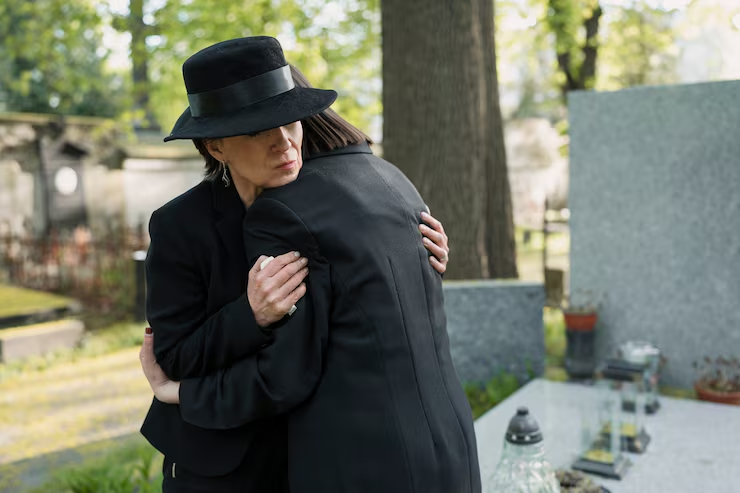
The Final Reckoning: Dismantling the Golden Cage Built with Love
That Tuesday morning, I stood in the kitchen, the house suffocating under the silence that only death can impose—not the gentle quiet of sleep, but an oppressive absence that screamed louder than any noise. The scent of Linda’s jasmine tea still lingered, a ghost refusing to leave, clinging to the curtains and the corners of rooms where she had spent thirty-eight years making this house a home.
Her favorite mug sat on the counter exactly where she’d left it three days before the cancer finally won, a faint, perfect circle of coral lipstick—that same shade of Revlon she’d worn since 1985, a color she would never wear again. My wife of thirty-eight years was gone, and for two days I had been submerged in the terrible logistics of planning her funeral.
A task our only child, Rachel, should have been helping me with.
My name is David Miller, I’m sixty-three, and I was about to confirm the horrifying truth: the daughter Linda and I had sacrificed everything for valued a wine-tasting trip more than saying a final farewell to her own mother.
The Anniversary Over the Afterlife
I finally called her, my thumb resting on Rachel’s contact photo—a bright picture from her wedding seven years ago, back when she still looked at me like I was her hero, not her personal bank. Rachel answered on the third ring, her voice bright and far away, the distinct sound of someone already distracted by something more important than the man calling her. “Hi, Dad. What’s up?”
I laid out the details with a voice I barely recognized, hollow and mechanical, like I was reciting a stranger’s script. “The funeral is Thursday. Eleven a.m. at Grace Presbyterian. You’re scheduled as a pallbearer, so you need to be there by ten-thirty for the family gathering.”
A pause stretched between us, and I held my breath, waiting for her to break, to ask how she could help. I was tragically wrong.
“Oh, Dad, I really can’t make it,” she responded, her tone carrying the same easy regret you’d use to decline a lunch invitation. “Ethan and I have our anniversary trip this week. We’re flying to Napa tomorrow morning. It’s been planned for months—we have reservations at three Michelin-starred restaurants. It’s kind of our big yearly splurge, you know?”
My hand clenched the phone so tightly my knuckles went bone-white. It couldn’t be true. My daughter—the child Linda had fought for, nursed through every illness, driven to every practice—couldn’t possibly be saying what I thought she was saying.
“Your mother’s funeral is this Thursday, Rachel,” I repeated slowly, each word landing like a stone. “The final goodbye.”
“I know, Dad,” she replied, followed by a short, awkward laugh, as if I’d made an inappropriate joke. “But here’s the thing: you can’t bring Mom back no matter when the funeral is, right? And our anniversary only comes once a year. Ethan booked everything back in June—the hotel, the wine tours. Canceling would be such a waste of money. You know how expensive these places are.”
Her justification felt like a series of physical blows.
“Mom was all about living life to the fullest, right?” Rachel pressed on, clearly convinced of her own logic. “She’d totally understand. She always said not to put life on hold for things you can’t change. I’ll do something special later to honor her—maybe plant a tree. But this trip is non-refundable, Dad.”
The call ended with hollow promises to “visit soon.” I stared at the dead phone, her excuse echoing painfully.
That afternoon, still numb, I found the funeral program. I picked up a pen and, with a slow, deliberate motion that felt like an irrevocable step, I drew a single, heavy black line through my daughter’s name on the list of pallbearers. It wasn’t born of blind rage or petty revenge. It was an action fueled by painful clarity, the stark realization I’d spent years avoiding: my own daughter only cared about us when we served her needs.
The Empty Space
The morning of Linda’s burial was gray and wet, the October sky weeping the tears I hadn’t been able to shed. At the cemetery, a cold wind whipped my coat, making the flower arrangements shiver.
Friends and neighbors gathered close, offering quiet condolences. I stood at the front, accepting their hugs, while some pathetic, stubborn part of me kept scanning the distance, waiting for the sound of Rachel’s blue Lexus.
It never came.
Linda’s sister, Patricia, approached me before the service began, her expression a careful mix of sorrow and confusion. “David, where is Rachel? Shouldn’t she be up here with you?”
I kept my eyes fixed on Linda’s mahogany casket. “She had important commitments,” I lied, the excuse tasting like ash. “She couldn’t change her plans.”
Patricia’s eyes widened, then narrowed with a mirrored anger. “What on earth could be more important than saying goodbye to her own mother?”
I couldn’t answer. As the pastor spoke about eternal bonds, all I could feel was the canyon-like absence to my left, the empty space where my daughter belonged. I realized that Linda’s unwavering loyalty to Rachel had been a shield our daughter now hid behind, even in death.
When it was time, I threw the first shovel of dirt onto the casket. The hollow thud of earth hitting wood was the sound of a door slamming shut forever—not just on Linda’s life, but on the illusion of the family we were, the lie I’d told myself that my daughter was simply busy, not fundamentally selfish.
The Note and the Ledger
Later, in the crushing silence of our home, I was drawn to Linda’s bedside table. Tucked inside her Bible, marking the book of Proverbs, was a folded note.
My dearest David, her neat script read, slightly shaky from her illness. Please don’t let Rachel forget us. We gave her everything we had. I hope that was enough. I hope we taught her what matters. I’m worried we didn’t. Love always, L.
Written weeks before she died, during one of those terrible, lucid moments of painful clarity, Linda had known. She knew Rachel loved the support we provided more than she loved us.
It hadn’t been enough. All our sacrifices, all our love, all our endless support—none of it was close to enough.
I spent the rest of the night in my study, pulling down the file boxes I’d meticulously kept since Rachel was born: Rachel, Education. Rachel, First House. Rachel, Wedding. I pulled every receipt, every wire transfer confirmation, every canceled check. I created a new spreadsheet, quantifying the abstract horror.
- Down payment on her first house: $350,000, given as a gift.
- The wedding celebration: $75,000 for one single day.
- Master’s degree tuition she never completed: $48,000.
- Countless “emergency loans”—for remodeling, unexpected trips, car repairs—that were never once repaid.
The final figure glared back like a harsh judge: $893,000. Nearly a million dollars, freely given from a place of trust and the naive belief that financial support was the same as imparting values.
In that moment, something inside me didn’t break; it hardened. It became clear and cold and absolutely certain. Rachel had made her choice. Now, I would make mine.
The Word “No”
The phone rang at 9:15 the next morning. Rachel’s cheerful face appeared on the screen.
“Hey Dad,” she chirped, her voice impossibly chipper. “How are you holding up? I’ve been thinking about you.”
“I’m managing,” I stated flatly.
Her tone shifted immediately to the sweet, practiced cadence she used whenever she was about to ask for money. I’d heard this voice for years and had always mistaken it for affection.
“So, listen, I need a quick favor,” she began, confidence oozing through the phone. “We went a little overboard celebrating in Napa. The credit card bills are rolling in, and we’re about $15,000 short this month. Could you just wire it over today? You know how these things pile up.”
I listened, stunned. She was asking me to fund the lavish party she’d chosen over her mother’s burial.
“Fifteen thousand dollars?” I repeated, my voice dangerously calm.
“Yeah, but it’s not a huge deal, right?” she said quickly. “You’ve always been there for me. You’ve always said family helps family.”
“Rachel,” I said slowly, “your mother’s funeral was yesterday.”
“I know that, Dad,” she replied, a flicker of irritation entering her voice. “But she’s gone now. You can’t bring her back. These bills are here right now, and they need to be paid now. I’m asking for your help with something we can actually fix.”
Every sacrifice Linda and I had made coalesced into that one, grotesque request.
“No,” I said. The word felt foreign, powerful, like discovering a long-forgotten language.
Stunned silence followed. Then: “No? What do you mean, no? Are you having money problems? Is the business struggling?”
“No, Rachel. I mean I am not giving you the money.”
Her tone snapped immediately into cutting accusation. “This is unbelievable! Mom just died, and you’re being petty about money? She would be so disappointed in you right now! She would want you to help your family when we need it!”
“Your mother wanted you at her funeral,” I said evenly.
“Fine!” she snapped. “Then don’t expect us to come around much anymore if this is how you’re going to be. If you’re going to use money to control us, we don’t need that kind of toxic relationship!”
The threat was old, the same one that had worked for years because I’d been terrified of losing my only child.
“I understand,” I said calmly, and hung up before she could respond. For the first time, I had ended the conversation on my own terms.
The Termination
I walked straight from that phone call to my office and dialed my HR director, Monica.
“Monica, I need you to prepare termination documents for Rachel Miller. Standard protocol. Security escort. Have everything ready this afternoon.”
Monica knew our family well. “Are you certain, David? This is a serious step.”
“I’ve never been more certain of anything,” I replied.
Rachel had been in our marketing department for eight years—a generous salary, an impressive title, and a position she treated as an entitlement.
She strolled in at 9:30, Starbucks cup in hand, late as usual.
“Rachel, my office. Now,” I said over the intercom.
She walked in smiling, but the smile dissolved when she saw Monica sitting across from my desk.
I slid the termination documents across the desk. “Your employment with Miller Manufacturing is terminated, effective immediately.”
Her face went white. “You can’t be serious. This is a family business! You can’t fire family!”
“This is a business,” I corrected. “And your performance has been unacceptable for years. Multiple missed deadlines. Inflated expense reports. I should have addressed this long ago.”
“This is revenge!” she accused, tears forming. “This is because I didn’t go to Mom’s funeral!”
“This is a business decision, Rachel. Your attendance at the funeral doesn’t change the fact that you’ve been underperforming for eight years.”
“Mom wouldn’t want this,” she pleaded.
“Your mother isn’t here,” I said quietly. “And that’s partially your choice.”
Security escorted her out fifteen minutes later. I took the staged photo of Rachel from my office wall and placed it face down in a drawer. The empty space felt cleaner, lighter, as if a great weight had been lifted from the entire room’s foundation.
The Domino Effect
News travels fast in a small town, but scandal moves like wildfire. I didn’t have to justify my decisions. I simply told Patricia the unvarnished truth about the Napa trip and the money request. Patricia told her bridge club, they told their husbands, and soon, everyone in our social circle knew what Rachel had done.
The social consequences were swift and silent. Invitations dried up. Ethan’s golf partners suddenly had conflicting commitments. Reservations at their favorite restaurants became mysteriously impossible to secure. The community was drawing a firm line, and Rachel and Ethan found themselves on the wrong side of every judgment.
Then, I began the systematic financial dismantling of the life I’d built for them.
First, I contacted their mortgage company and withdrew my name as guarantor on their home loan—a guarantee that was the only reason they qualified for the house they bought. Without my name, the bank immediately called the loan. The foreclosure notice arrived at their door within a week.
Next, I contacted the dealership for Ethan’s BMW, a lease I was guaranteeing. I withdrew the guarantee. The BMW was repossessed from their driveway in broad daylight while neighbors watched.
Finally, I contacted every credit card issuer for the cards I’d co-signed over the years. I had my name removed as an authorized user and guarantor. The cards were suspended immediately.
Thread by thread, every safety net Linda and I had woven beneath their lives over decades of enabling was meticulously cut away. Each thread severed with the same careful precision I’d used to build my business, to provide for my family, to create the comfortable life we had worked so hard to achieve.
The Only Inheritance Worth Giving
The garage sale was the final, devastating chapter.
I drove past their house that Saturday morning—not out of a desire to gloat, but because I needed confirmation, a visceral check that the consequences I had set in motion were indeed real.
Their front yard was overwhelmed by their possessions: the expensive wedding gifts we’d bought them, now selling for next to nothing. Designer bags Rachel had collected, priced at the cost of a simple lunch. The furniture we’d helped them choose, marked down in a desperate scramble.
Rachel stood near a card table covered in small items, her face drawn and tired, haggling with a customer over an old picture frame.
The house itself—the one I’d provided the down payment for, in the coveted neighborhood they had required—was scheduled for auction on the courthouse steps the next month. I quietly arranged for a holding company I owned to submit the winning bid. Not because I wanted the property, but to deny them the satisfaction of knowing who claimed it.
The collapse was total. Methodical. Irreversible.
Ethan’s wife, Megan—I had permanently stopped thinking of her as my daughter-in-law—left him for an ex-boyfriend who owned a restaurant chain. Ethan retreated to his parents’ house in Florida.
Rachel was left alone in a small studio apartment above a laundromat on the edge of town, working a call center job for fifteen dollars an hour—the same job she could have secured right out of high school without the incomplete master’s degree I’d financed.
The Apology That Was Just a Request
She appeared on my doorstep one Tuesday evening, about three months after the burial, looking ten years older than she had that summer. Her hair was pulled back simply. No makeup. Jeans and a basic t-shirt replaced the designer wardrobe.
“Dad,” she began, her voice breaking immediately, “I know I made catastrophic mistakes. I should have been at Mom’s funeral. I was cruel and utterly selfish, and I can never take it back. I’m… I’m so sorry. I’ve lost absolutely everything—my house, my marriage, my friends, my job. I am desperate for help. Please.”
Her words were clearly practiced, but the sheer desperation was raw. The tears were genuine. The complete brokenness was impossible to ignore.
I stood in the doorway, making no move to invite her in, simply studying the daughter I barely recognized.
“When is your mother’s birthday?” I asked quietly.
She blinked, confused by the shift. “June… June 15th?”
“July 10th,” I corrected. “What was her favorite flower?”
“Roses?” she guessed, her voice filled with uncertainty.
“Daisies,” I stated. “She loved daisies. They were simple and cheerful, and she had a whole garden of them that you never once seemed to notice.”
The silence between us was a vast canyon, filled with everything she had failed to see, failed to care about, and failed to remember during thirty-five years of being Linda’s daughter.
“She was afraid of this exact moment,” I told her, my voice drained of anger, replaced by a cold finality. “Your mother was afraid you only loved us for what we could give you, not for who we actually were.”
“That’s not true,” Rachel whispered, tears finally streaming down her face. “I do love you. I just… I lost sight of what mattered. I got caught up in maintaining an image, in keeping up appearances, in—”
“In using us,” I finished for her. “In taking every single thing we offered and never once bothering to ask what we might need.”
“I am so sorry,” she choked out. “Please, Dad. I truly have nowhere else to go.”
I didn’t offer comfort. I didn’t open the door wider or pull her into an embrace. I simply took a small step back, allowing the physical gap to perfectly represent the vast emotional distance she had created over years of entitlement.
“I can’t help you, Rachel,” I said softly. “Not because I lack the means, but because helping you now would teach you absolutely nothing. You have to learn to stand on your own two feet, to fully comprehend what you’ve lost, to become a person your mother could have been proud of.”
I closed the door gently. I listened to her crying on my porch for a few agonizing minutes before I heard her footsteps walk away down the path.
The True Legacy
A year after Linda died, the Linda Miller Memorial Foundation opened a community center on the east side of town—the neighborhood where Linda had grown up, where she’d learned the true value of compassion and hard work.
The center provided after-school programs for vulnerable kids, offered tutoring, gave job training to adults, and funded college scholarships for underprivileged students who demonstrated character alongside academic potential.
Linda’s legacy was not going to be an inheritance squandered by a selfish daughter. It was going to be a living, breathing force for good in the community she cherished.
Rachel was there for the ribbon-cutting ceremony, standing quietly at the very back of the crowd. She made no attempt to be in the photos or claim any connection to the foundation bearing her mother’s name. She simply stood and watched.
She approached me afterward, near the newly planted flower garden filled with white and yellow daisies—Linda’s favorites, the ones Rachel had finally remembered.
“They’re daisies,” she said softly, nodding at the flowers. “I remembered this time.”
She told me she was volunteering at a local food pantry three days a week after her call center shift. That she was attending a support group for financial rebuilding. That it felt odd but right to be doing something that genuinely helped people, something that didn’t revolve around her own wants.
It was a start. A small, uncertain, fragile start.
I didn’t offer forgiveness in words. I didn’t say that everything was fixed or that we could return to the past. Because we couldn’t, and I knew I wouldn’t want to even if we could.
But I didn’t turn away, either.
“Keep going,” I said, my voice neutral but not unkind. “Show me who you can become when you stop taking and start giving. Show me that your mother’s lessons weren’t entirely wasted.”
She nodded, tears in her eyes, and walked toward her beat-up Honda Civic parked far away from the official cars.
The Hardest Lesson
I’ve learned, through the most difficult pain imaginable, that love without respect is merely dependency. That loyalty without accountability fosters only entitlement. And that sometimes, the kindest thing you can do for someone you love is to stop rescuing them from the inevitable consequences of their own choices.
By drawing a line, by allowing Rachel to fall, and by refusing to continue enabling the selfishness that had defined her adult life, I hadn’t just protected Linda’s memory—I had given Rachel something our money never could: a chance to discover who she was when there was nothing left to take, when the safety nets were gone, and when she had to rely solely on her own strength and character.
Linda’s Bible still sits on my nightstand, her note still tucked into Proverbs. I read it sometimes, when doubt creeps in about the severity of my actions.
Please don’t let Rachel forget us. We gave her everything we had. I hope that was enough.
It wasn’t enough when we simply gave money and fixed problems. But maybe—just maybe—it will be enough now that Rachel is forced to remember us, to confront what she lost, and to rebuild herself into someone capable of genuine love instead of transactional relationships.
In the end, that painful, necessary lesson might be the only true inheritance worth giving—the gift of having to become someone worthy of the love they were so freely given and then squandered.
I see Rachel occasionally at the community center, helping kids, organizing donations, slowly, painfully becoming someone her mother might have recognized. We don’t share family dinners. We don’t exchange gifts. We are not “close” by any conventional measure.
But she is trying. She is working. She is learning that love is about sacrifice, about showing up, and about putting someone else first even when it is wildly inconvenient.
She is learning what her mother tried to teach her all along.
And I think, finally, Linda would be proud—not of who Rachel was when she chose Napa over the funeral, but of who Rachel is slowly, painfully becoming in the ruins of the life she lost. That is the hope Linda ultimately left behind: the conviction that even the most selfish heart can learn to love genuinely, if the lessons are hard enough and someone who loves them is brave enough to stop enabling and demand better.
Trending Right Now:
- My Mother-in-Law Tried On My Wedding Dress and Destroyed It — So I Made Her Regret It Publicly
- He Cheated. She Laughed. I Served Them Both a Slideshow of Karma
- “I Overheard My Husband and Our Neighbor’s Daughter — So I Came Up With a Plan She Never Saw Coming”
- He Couldn’t Move, But He Knew Something Was Wrong — So He Looked Up
- I Gave a Ride to a Homeless Man — The Next Morning, Black SUVs Surrounded My Home
- I Married My Former Teacher — But Our Wedding Night Revealed a Secret I Never Saw Coming


Leave a Comment