
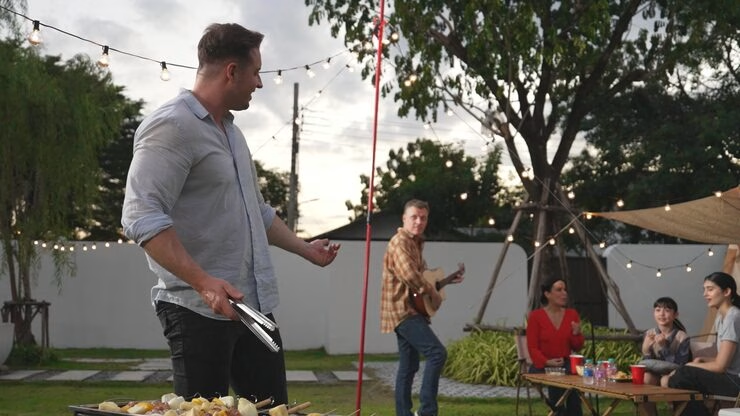
The Summer Gathering’s Startling Reveal
The scent of burning charcoal and cheap, lukewarm lemonade hung heavy in the air of the backyard barbecue. It was the kind of event where the plastic folding chairs always sank a little too deep into the recently mulched lawn, and the afternoon promised nothing more exciting than mild sunburn and a fresh collection of mosquito bites. It was designed to be casual, a low-stakes gathering where I could simply be present, blend into the background—my usual role. I arrived ready to disappear, holding a generic six-pack, already mentally preparing for my inevitable relegation to grill duty. This day, I assumed, would be no different from any other routine family obligation. I was there to support, to offer my presence without drawing attention, to simply exist on the periphery of the family’s orbit. There was absolutely no expectation of anything remotely dramatic.
But then, Grandma spoke. She possesses a voice that does not merely speak; it announces. It is a cheerful, booming sound, capable of cutting through the thickest crowd chatter, like a sudden, unexpected toast being offered.
“Your car loan is fully paid now!” she declared, her face beaming with an almost aggressive cheerfulness as she raised her plastic cup of beverage. “Twelve grand is no joke, but you’re worth every penny, Kevin!”
The sudden flow of easy conversation and laughter around the patio table didn’t cease immediately. Instead, it stuttered, then faltered, and finally died in a drawn-out, agonizing process. The shift in atmosphere was palpable, suffocating. My uncle Andrew, usually the source of an immediate, easy joke, merely stared fixedly into the amber depths of his beer bottle. My mother, who had been meticulously slicing a large watermelon, became perfectly still, her knife frozen mid-air above the pink fruit.
I found myself blinking, a half-chewed bite of burger still lodged uncomfortably in my cheek, trying desperately to process the words. My loan. Twelve thousand dollars. A car. The concepts refused to align.
“Grandma,” I managed to say, forcing a sound that was supposed to be a chuckle, “I don’t even own a car. I commute via the train.”
The silence that followed was thick, heavy, and deeply suffocating. Grandma’s triumphant smile visibly twitched. For a brief, agonizing fraction of a second, her expression was one of pure confusion, a quick flicker of panic hidden in her eyes as she darted a glance to her left.
And then, with the impossible timing of a theatrical entrance, as if she had been waiting for the exact moment the collective breath was held, my sister, Chloe, walked in through the side gate. She was radiant, wearing a wide, knowing grin, holding up a brand-new set of keys for all to see. The fob, a piece of dangling chrome and vibrant red, swayed from her finger like a celebratory pendant.
“She’s finally here!” Chloe announced, her voice overflowing with either genuine obliviousness or a perfectly executed, chilling awareness. “Isn’t she absolutely beautiful?”
Not a single person around the table offered a word in response. Not Mom, who slowly, deliberately, resumed the task of slicing the watermelon. Not Dad, who suddenly found the answers to all the universe’s questions etched into the pattern of his disposable paper plate. Everyone simply… shifted. It was that intensely uncomfortable, collective squirm of individuals who are all privy to a secret you have just, through sheer accident, stumbled upon.
It was in that pregnant, awful moment that the truth crystallized. This was not an accident. This was not a simple misunderstanding or a case of a geriatric memory lapse. I was not supposed to know. I was certainly not supposed to ask. They had deliberately opened a line of credit, secured a substantial loan, and acquired a car, all of it meticulously orchestrated under my name. And they genuinely believed I wouldn’t notice the seismic shift in my financial universe. Or, the thought that truly sent a shiver down my spine: they thought I would simply swallow it whole. Like I always do. They assumed I would flash a polite, weak smile, nod curtly, mutter, “Glad you’re happy, Chlo,” and then quietly sign over another piece of myself—my financial solvency, my credit score, my emotional peace—to discreetly cover their actions.
I made no move to argue. I didn’t confront the beaming circle of faces. I didn’t shout or demand explanations. I simply remained standing there, the skin across my arms beginning to prickle uncomfortably under the intense summer sun. I could feel a hundred silent pairs of eyes fixated on me, waiting. They were waiting for the “reliable one” to perform his assigned function. They were waiting for me to smooth over the situation. They were waiting for me to instantly make them feel comfortable and innocent once more.
I finally sat back down. I picked up the remnants of my burger. And I took a deliberate, slow bite. The suffocating spell of silence was finally broken. The nervous chatter cautiously, tentatively, resumed, like water flowing around the new, deep crater I had just silently plummeted into.
Two agonizing hours later, the main group had migrated inside, their voices merging with the sounds of laughter directed at some ridiculous TikTok video playing on the big-screen TV I had purchased for them last Christmas. I seized the moment. I quietly pulled out my phone. My hands, surprisingly, felt completely steady. I logged into my primary banking application. Then I opened the secondary credit monitoring application.
The verdict was immediate. Approved. Twelve thousand dollars. Cleared and formalized in my name. The demand for the first payment was already listed.
I didn’t utter a sound. My hands never shook. My jaw never tightened. A specific, vital component inside my chest just seemed to instantly go cold and flat. I quietly closed the financial apps, noted the date, and took a screenshot of the chilling loan approval page.
When I finally looked up, Grandma was standing over me. The veneer of the cheerful matriarch was completely gone. Her face was drawn and grim. She carefully avoided making eye contact with me. Without a word, she simply reached deep into her enormous purse, produced a thick, bright yellow folder, and slowly slid it across the patio table. Then, as silently as she had arrived, she turned and retreated back into the house.
I knew what was inside. The printouts. The contracts. The dealership papers. The entire paper trail of the crime. All of it signed by “me.” Except, I hadn’t signed a single, solitary thing.
Late that night, precisely at 2:03 a.m., my phone, which was charging innocently on my nightstand, suddenly lit up. It was a cascade of angry, desperate notifications. Thirteen new text messages. Five urgent missed calls. And a single, lengthy voicemail from my sister, Chloe, her voice a frantic, tearful whisper.
“Please, don’t do anything crazy, okay? Just call me back. Please.”
I never replied. In my mind, I had already executed something far more significant and devastating than any simple, crazy act. I had gone silent.
📁 The Collection of Stolen Trust
The bright yellow folder remained perched on the edge of my kitchen counter for three days. I treated it like a dangerously cursed object. I refused to touch it at first, letting it sit there, a garish, luminous monument to my own shocking naivety. It was a brightly colored relic that existed solely to dare me to open it and finally confirm the profound, sick reality I already fully understood.
I maintained my routine. I continued to work, managing the demanding backend infrastructure for a dozen clients through my busy tech consulting business. I answered all emails promptly. I optimized complex networks. I kept the machinery of my professional life running smoothly. But every single time I walked into the kitchen to grab a needed cup of coffee, the folder was there. Staring at me. A constant, blinding reminder.
On the third night, when the concept of sleep felt like a cruel, impossible joke, I finally gave in. I meticulously spread the contents of the folder across the surface of my dining room table, illuminated by the cold, stark light of the overhead lamp. And it was there, in that clinical, unsparing light, that the pattern, the terrifyingly larger and truer story, finally snapped into sharp focus.
It was never just about the car. The twelve-thousand-dollar car purchase was merely the loudest, the most arrogant, the most recent offense.
I found the utility bill from the previous autumn. The one my mother had nervously dismissed as “probably a glitch” when I had casually inquired why my automatic payment had been debited from my account twice. The paper copy was right here, mailed directly to their address, with my specific account number listed in bold.
I found the paperwork for the second streaming service—the one my dad had pretended he “didn’t know” I was still paying for, despite the fact I had painstakingly removed all of their profiles from my master account months prior. They hadn’t stopped using it; they had simply re-subscribed, using my stored payment information, without permission.
I found the receipt for the five-hundred-dollar school deposit for my sister’s child. A “temporary” loan, she had promised me earnestly. Just until I get paid, Kev, I swear. The payment had never been returned. The subject had never even been mentioned again.
I meticulously traced the dates. I carefully aligned the charges. Every single favor I had ever extended had, in their minds, instantly been converted into a precedent. Every dollar I had quietly covered had morphed into an explicit expectation. And every single instance of my silence—every time I failed to push back, every time I just sighed wearily and said, “It’s fine, please don’t worry about it”—had been deliberately interpreted as absolute permission.
I was not their family member. I had been their designated funding source.
I felt a profound, deep sense of being used. Not just financially, but far more devastatingly, emotionally. And the absolute worst part, the realization that made my stomach churn and clench, was the undeniable fact that they knew it.
Grandma’s meticulously prepared folder contained all the receipts—both the literal paper ones and the figurative, ugly tally of their moral debts. Dealership printouts. Multiple insurance plans. My sensitive financial details, my entire social security number, all neatly typed out. Pages and pages documenting bold, aggressive moves that had been executed using nothing more than stolen trust and forged familiarity.
I finally flipped to the last page. The binding finance agreement. And there, at the bottom, was the final, sickening detail: my own signature. Or, rather, a clumsy, laughably insulting attempt at duplicating it. They had crudely photocopied it from an innocuous document I had signed for a summer internship years ago, then sloppily traced it onto the finance agreement. They hadn’t even bothered to try to make it look convincingly real.
Why would they? They never needed to exert the effort. I was the reliable one. The quiet one. The one who was guaranteed not-to-make-a-scene.
The flashbacks hit me, not as vague, depressing feelings, but as sharp, distinct, utterly clear memories.
My thirtieth birthday. They had assured me they were only doing a “small, intimate family dinner,” and the table, they explained, “only fit ten people.” I was, pointedly, not invited. Yet, my bank statement for that specific month clearly showed a six-hundred-dollar charge for catering, an enormous order I never placed, linked to my shared Amazon account.
My cousin’s wedding. I had “offered” to pay for the expensive floral arrangements as my large gift. When I arrived at the ceremony, I picked up a program. My name was not listed anywhere. Not even as a general guest.
The group vacation. I had been asked to cover the entire rental deposit, a cool thousand dollars. The subsequent “thank you” text I eventually received was a forwarded message, a complaint my aunt had clearly meant to send to someone else, whining that the place I paid for didn’t have a good enough view.
Every single memory in my head suddenly rearranged itself. They were not isolated, petty insults. They were meticulously collected data points. They represented a long, silent, and entirely deliberate betrayal. They didn’t, perhaps, love me less; they just valued me exclusively for what I gave far more than they valued who I was.
And I, shamefully, had allowed them to do it. I had permitted them to condescendingly tell me I was “lucky to be included.” I let them laugh awkwardly when I offered to help, because “helping” had quietly become the only method by which they knew how to accept my presence.
But the stark truth was now undeniable, laid out in black and white and that offensive, screaming highlighter yellow. They had successfully spent twelve thousand dollars using my name, bought a brand-new car, handed the keys directly to my sister, and smiled through the entire charade as if it were a simple, benevolent blessing. They did this because they absolutely assumed I would do exactly what I always did: pay the bill, silently disappear back into the background, and patiently wait for a meager scrap of gratitude that would, naturally, never materialize.
This time, however, they had fundamentally miscalculated. This time, I had blinked, and I had seen it all.
That same night, I logged into every single bank account I owned. I instantly changed every password. I meticulously froze every automatic payment. I pulled my full, detailed credit report. And then, as the clock ticked past four in the morning, I placed a call to the dealership’s twenty-four-hour financing line.
“Hello,” I said, my voice unnervingly calm. “I believe a car was recently purchased under my name without my express consent.”
The man on the other end of the line immediately went completely silent. Then he quietly asked, “Is your name Kevin?”
“Yes,” I confirmed.
He emitted a long, weary sigh. “I had a feeling you would eventually call.”
💻 The Calculated Digital Severance
The dealership representative’s voice retained the practiced, flat tone of a person trained in customer service, but the subtle, weary edge underneath his words conveyed everything I needed to know. He was aware. Not of the intricate, intimate family betrayal that had led to this call, not yet. But he had certainly seen this particular brand of disaster before—the kind that always comes thinly dressed up in the guise of family signatures.
“You are technically the listed owner,” he added, the unsaid sir hanging heavy in the digital air between us.
I did not respond immediately. I simply stared at the incriminating folder Grandma had slid across the table, the stack of documents that felt less like evidence and more like a final courtroom verdict. I hadn’t slept a wink. My hands were utterly steady. My jaw remained slack and calm. Something deep inside my core had been sharpened to a razor-fine edge.
I wasn’t interested in receiving a worthless apology. My sole focus now was leverage. I was finished with the act of playing the quiet, agreeable martyr.
“You will be picking the car up tonight,” I stated clearly. It was not phrased as a question seeking confirmation.
There was a brief, tense pause. “Yes, sir. I will initiate the repossession protocol immediately.”
I hung up the phone and opened my laptop. For the next seven hours, I seamlessly transformed into the very thing they feared most: the quiet, reliable man who had finally, decisively, decided to make noise. I began the execution of a highly precise, five-phase strategic shutdown.
Phase One: Reclaiming Boundaries
The initial targets were the accounts. The minor, everyday luxuries and comforts they had so casually taken for granted.
- Netflix: Gone. All profiles meticulously erased, including the “Family Fun” one with Grandma’s most-watched shows bookmarked.
- Spotify Premium: Swiftly downgraded to the free tier. Five different people were about to experience the sudden, jarring shock of listening to commercial advertisements.
- Amazon Prime: Revoked. No more entitled free two-day shipping for birthday gifts they always forgot to send me.
- Password Manager: Fully reset. Every single shared login—for streaming services, for news sites, for online shopping—was instantly rendered useless.
I had originally built their smart-home setup for them. I now proceeded to methodically dismantle it.
- Thermostat: Remotely locked at a preset, uncomfortably neutral temperature.
- Security Cameras: Completely offline.
- Wi-Fi: The access point, connected to my professional, business-grade router, was unplugged.
My phone started lighting up within the hour, exactly as predicted.
Mom: Hey, something’s wrong with the Wi-Fi. Can you please fix it?
Dad: Did the thermostat reset? It’s strangely cold in here.
Chloe: Why is the camera app saying ‘unauthorized device’??
I did not reply to any of them. I was merely laying the initial groundwork.
Phase Two: Financial Extraction
The mortgage. I had foolishly co-signed it five long years ago. “It’s strictly temporary,” my dad had reassured me. “Just until things stabilize.” But things had, predictably, never stabilized. Why would they, when I was always there, acting as the completely reliable buffer?
I logged into the lender portal and immediately initiated the complex process to remove myself from the loan documentation. This action automatically triggered an immediate review by the bank. The loan officer called me within the hour.
“Mr. Patterson?” the representative asked, a note of sincere concern in his voice, “I’m concerned they simply won’t qualify for the mortgage without your substantial income.”
“Good,” I replied simply.
The rep wisely chose not to argue the point further.
Two days later, the bank formally emailed them an updated, brutal loan estimate. Without my name and income, their required monthly payment would nearly double. The choice was stark: either try to refinance at a terrible, new, crushing rate, or ultimately lose the house. I didn’t call to warn them. I let them discover that chilling email themselves, perhaps over their morning breakfast. I let them frantically try to call me when their dependable buffer stopped buffering.
Phase Three: Asset Audit
I meticulously dug deeper, past the superficial subscriptions and the obvious utility bills.
I located the old lease for the storage unit I had been secretly paying for, the one containing half of their supposed “family heirlooms.” I immediately called the facility and cancelled it. They now had exactly thirty days to clear it out.
I found the hosting account for the sentimental “family photo site” they religiously used every holiday season. I hit the delete button.
I pulled up the domain registration for my father’s little tax-prep side business. Guess who had quietly paid the annual renewal fee for the last six years? I swiftly transferred the domain to a secretive, private registrar and locked it down. Then, I called the accounting software provider and permanently revoked their license. All of their tax records were suddenly, completely inaccessible.
I wasn’t stealing a single thing. I was merely reclaiming what was fundamentally mine.
Phase Four: The System Shutdown
Years ago, when I first started my company, I had generously given them access to the exact same powerful, professional tools I deployed for my large corporate clients: high-grade firewall protection, deep network optimization, secure encrypted backups. They truly believed I was just “being helpful.” They never bothered to read the technical paperwork.
I logged into my firm’s secure backend. I quietly reclassified both existing accounts—my parents’ home network and my uncle’s small medical clinic—from the status of “Family Access (Free)” to “Terminated.” The system immediately cued a full, comprehensive disablement of all services. I left only a single, cold, efficient note on both of their administrative dashboards:
This infrastructure was voluntarily maintained at no charge since 2016. Effective immediately, all associated services have been permanently revoked.
No emotional language. No advance warning. Just absolute, final digital severance.
At precisely 6:12 p.m., my uncle left a voicemail, his voice a panicked, confused mixture of half-panic, half-incredulity. “Kevin? We can’t log in. Our files, our important patient files… they’re all gone. Were we hacked? Call me ASAP!”
I did not return the call.
At 6:45 p.m., a message arrived from my dad, all pretense of concern finally evaporating.
Dad: You have gone too far. This is not just about the car.
No. It was never just about the car.
Phase Five: Strategic Exposure
I still possessed the crucial screenshots. The dealership forms with the obviously fake signature. The loan approval documentation. Grandma’s damning yellow folder. I carefully compiled them all into a single, meticulously time-stamped, perfectly organized PDF document. Then, I sent that single file to three critical contacts: my family’s longtime accountant, a specialized fraud investigator I knew from a past client engagement, and my own personal lawyer.
By nine o’clock that evening, a concrete legal plan was fully in motion. The stolen car was actively being repossessed. The significant fraud had been formally reported to the police. My fragile financial ties to them were completely, officially severed. Their technological infrastructure was utterly offline. And every one of their ugly, hidden secrets was now meticulously documented.
I didn’t allow myself to scream. I didn’t post a single word online. I didn’t call a soul. The silence I now maintained was not a simple act of retreat. It was a final, devastating verdict.
By the stroke of midnight, my phone displayed one hundred and twelve missed calls. Thirteen from my sister. Twenty-one from my dad. Two new voicemails from Grandma—one filled with theatrical tears, the other boiling with raw, unadulterated anger. But I didn’t listen to a single one. I already knew exactly what they were trying to say.
You’re tearing this family apart.
No. They were the ones who had torn it apart, piece by piece, over years. I had merely stopped taping it back together.
🌪️ The Whirlwind of Accusation
They didn’t call with sincere apologies. They never do. They called with a singular objective: to control, to urgently manipulate, to desperately remind me that I was one of them, even after the profound, systematic betrayal they had just perpetrated.
The night the newly purchased car was finally repossessed—a dramatic, public event I imagined—my phone did more than just vibrate; it seemed to literally scream. It instantly lit up with frantic notifications, as if a small digital bomb had exploded within a family group chat I had long ago wished to leave.
Chloe was the first to react.
Chloe: They took the car. They said it’s gone forever. WHAT DID YOU DO?
Then my mother, attempting a familiar tactic.
Mom: Kevin, please, just call us. We simply don’t understand why you are doing this. This is just a simple misunderstanding.
Then my father, shedding all remaining pretense of parental concern.
Dad: This is childish behavior. You are embarrassing yourself. And you are embarrassing us.
I continued to maintain my perfect silence. They were not genuinely confused. They were profoundly exposed. They had finally stretched the leash of my tolerance too far, the fragile cord had violently snapped, and now they couldn’t stand the ensuing, painful recoil.
At 2:36 a.m., another frantic call came in. My sister again, this time clearly and audibly sobbing. “Kevin? They… they just said there might be criminal charges,” she wailed. “I didn’t know they would actually take it! I honestly thought… I thought you’d fix it.”
I ended the call instantly, without a spoken word. Because that simple, pathetic plea was the devastating core of it all. I thought you’d fix it. They had never once believed that anything I did had real-world weight or irreversible consequences. They genuinely believed they could steal, they could lie, they could forge signatures, and they could operate completely above the law, and I would simply step in, perform the expected patch job, silently absorb the financial cost, and ultimately protect them from the slightest consequence. Like I always, tragically, did.
Not this time.
By the following morning, their initial desperation had predictably mutated into something far uglier and darker: slander. My aunt quickly posted a vague, yet deeply passive-aggressive, missile aimed directly at me on her social media.
“It’s truly heartbreaking when family turns on you. But the TRUTH always surfaces eventually. We have receipts.”
Receipts. That was the ironic, insulting term they now chose to use for their collection of forged documents and stolen trust. They were already hard at work rewriting the narrative, desperately painting me as the selfish, ungrateful aggressor.
I offered no public answer. I allowed the profound power of my silence to achieve what mere words never could. But then the personal texts turned into direct, ugly attacks.
Uncle: You always desperately wanted attention. Well, you finally got it.
Mom: You have completely destroyed your sister’s life over a simple misunderstanding.
Dad: We took care of you when no one else in the world would. This isn’t justice. It’s cruelty.
Grandma: You think this makes you strong? It only makes you alone.
They desperately tried every angle possible. Guilt. Shame. Manipulation. Abject Pity. They pulled every lever in their psychological arsenal except the single one that genuinely mattered: accountability.
And when even that highly coordinated onslaught failed to break my resolve, they resorted to the final, oldest tactic. They showed up at my door.
No advance warning. No polite appointment. Just aggressive, pounding fists and clearly raised voices echoing loudly outside my apartment building. “Kevin! Talk to us! You are still our son!”
And then, I heard my father’s voice, now dangerously low and unmistakably menacing, cutting through the noise. “You will regret this deeply. You always come back to us. Just wait.”
I didn’t even go near the door. I certainly didn’t open it. They weren’t there to achieve resolution. They were there solely to regain control. They were there to enforce an immediate return to the comfortable status quo, where I kept my mouth shut and they remained perpetually comfortable.
That night, an email arrived from my mother.
Subject: You’ve made your point. Enough.
The body read: “We are immediately contacting a lawyer. This wasn’t fraud; this was family. If you continue with this campaign of harassing us, we will take immediate legal action against you.”
They truly believed they could instantly flip the script. That I was somehow the one who had fundamentally crossed the line. That filing a legitimate fraud report for something they had definitively done suddenly rendered me the malicious aggressor.
I did not respond to the email. Instead, I let them experience the growing vacuum. The frightening, complete absence of the fixer. By the next day, the desperate tone of the messages had completely changed.
Mom: Please, just talk to us. We are truly falling apart here. We honestly didn’t think it would ever go this far.
Chloe: I swear, I didn’t know what they were doing with your name. I just assumed you would be okay with it.
But she did know. They all did. They simply counted on my silence. And when they finally lost that powerful shield, they ultimately lost everything.
The Documented Reckoning
The initial impulse was always toward silence. At first, remaining quiet felt like the ultimate form of sophisticated revenge—it was cleaner, colder, more surgically precise. I had executed the financial severance; I could simply disappear. But then, the predictable, inevitable counter-offensive began: they started talking.
My sister, Chloe, launched the first salvo onto social media. It was a perfectly crafted Instagram post: a soft-lit, carefully filtered selfie, mascara strategically tear-stained for maximum effect. The caption was a textbook piece of passive-aggressive martyrdom:
It’s so incredibly hard when the people you thought would be your forever turn out to be your lesson. Grateful for the ones still here.
The performance was instantly successful. Within an hour, the post racked up over two hundred likes. The comments section quickly filled with a sickening chorus of digital solidarity: hearts, crying emojis, and self-righteous declarations like, “You absolutely don’t deserve this,” “Some people just want complete control,” and “Cutting toxic people out of your life is hard but totally necessary.”
I watched the narrative solidify. In their curated version of reality, I was the unstable one. The sibling consumed by drama. The bitter brother who had suddenly, inexplicably, snapped and “ruined absolutely everything.” I was the cruel person who took back a car and deliberately left his “baby sister” stranded, the villain who held the entire family hostage over a supposed “miscommunication” regarding a simple loan.
No one in that chorus of digital support knew the raw truth. More crucially, no one even bothered to ask. I understood with chilling clarity that if I didn’t finally seize control of the facts and offer my side, they would own the entire story—and their version would be the only one that survived.
So, I constructed the truth. Not as an emotional, unhinged rant. Not as a spontaneous public meltdown. But as a meticulously assembled file.
I wrote the post, choosing my platform with deliberate, professional precision. Not the emotional echo chamber of Facebook. Not the performative stage of Instagram. I chose LinkedIn. I wanted the truth to land exactly where it truly mattered: the professional, corporate world that knew me as a calm, highly capable, and collected consultant.
The headline was direct and clinical: A Case Study on Financial Exploitation and Identity Misuse within Family Structures.
I then recounted the core story factually, devoid of any personal fury or emotional hyperbole.
“For years, I operated as the unspoken financial buffer for my immediate family. This role recently escalated to my name and social security number being used to fraudulently secure a twelve-thousand-dollar auto loan for a vehicle I never saw, approved, or test-drove. This vehicle was subsequently gifted to another family member. When this profound misuse of identity was discovered, the family’s collective response was not an apology, but a coordinated attempt to silence and slander me publicly…”
I carefully refrained from naming any specific individual. I didn’t have to. Everyone who truly needed to understand the situation—my colleagues, my clients, my professional peers—knew precisely who the subjects were. Crucially, I attached a redacted copy of the loan approval documentation. A simple, undeniable piece of evidence.
By the close of the business day, the post had garnered over thirty thousand views.
Then came the flood of personal, private messages. They weren’t from strangers in the comments, but from people I hadn’t genuinely heard from in years. Former colleagues. College classmates. Distant acquaintances.
Thank you so much for saying this out loud. I honestly thought I was the only person this happened to.
My father forged my signature on a student loan application. My sister used my social security number for a private credit card. They still, to this day, blame me for the fallout.
They had the gall to call it ‘helping.’ I call it debt and theft.
I hadn’t set out to start a movement, but I had clearly struck a resonant nerve—a shared, ugly reality of financial trauma within families.
My immediate family noticed. And they noticed fast.
My mother immediately called me eleven times over the course of that single night. My father, employing his most imperious, corporate tone, sent a chilling email titled, “TAKE IT DOWN.”
You are embarrassing everyone involved. If you genuinely think airing our private family affairs online makes you look strong or principled, you are deeply wrong. Take it down immediately, or there will be serious, unavoidable consequences.
He signed it with his full, formal name, treating me like an adversarial stranger.
I didn’t dignify the threat with a reply. Instead, I calmly pinned the post to the top of my LinkedIn profile. Then, I took the final, most decisive step. I sent the full, unredacted PDF—the document containing every single receipt, contract, and forged signature—to their long-time family accountant. I attached only a brief, emotionless message:
In the event of an audit or financial review, please be aware that I did not authorize or initiate this particular purchase. A full report has been officially filed for financial misuse and identity fraud. All supporting documentation is attached for your records.
No anger. No threat. Just the pure, cold language of liability protection.
That same night, my cousin Ellie called me. “I saw absolutely everything,” she whispered, her voice genuinely shaking. “You need to know this… they’ve all been telling everyone you are dangerous. That you are deliberately trying to completely ruin the family on purpose.”
I let out a short, hollow, bitter laugh. “That,” I said flatly, “is precisely what people say when the designated scapegoat finally burns the mask, Ellie.”
“No, Kevin,” she insisted, her voice barely audible. “There was a formal meeting. Grandma, Uncle Ray, your mom and dad… everyone important. They are actively circulating printouts of fake messages. Messages they claim you sent them. I saw one of them. It claimed you were planning to sue every single family member, that you were covertly building a ‘revenge fund’ to take them all down.”
I thanked her for the critical information and immediately hung up. I instantly forwarded everything to my lawyer: the original LinkedIn post, the resulting slanderous comments, my father’s threatening and accusatory email, and Ellie’s terrifying report of a coordinated effort to fabricate evidence.
He replied ten minutes later with unsettling brevity.
Let’s set up a time to talk Monday. But F.Y.I., this entire chain of events is already easily enough for multiple charges of defamation, fraud, and a potential civil suit.
I still didn’t actively want a lawsuit. But the need to be ready was overwhelming. Because true, lasting power isn’t simply found in what you choose to say. It is found in what you can definitively prove.
By the next morning, their collective composure had cracked. The angry, demanding messages continued to cascade into my inbox.
Uncle Ray: Take the post down right now. You are absolutely humiliating your parents publicly.
Grandma: You should be deeply ashamed of dragging us through this awful business online.
Chloe: I truly hope it was worth it for you.
And for the very first time since the saga began, I chose to reply. To Chloe.
It wasn’t worth it, Chloe. It was necessary.
Then, I blocked her. Not out of the heat of blinding anger. But out of a sudden, desperate need for peace. When someone commits the profound act of emotional and financial identity theft, you don’t owe them the satisfying comfort of closure. You owe yourself, and only yourself, the absolute certainty of freedom.
They weren’t utterly furious because I had fabricated a lie. They were incandescent with rage because I had simply told the truth.
🚪 The Final Doorstep Verdict
They did not come to my apartment seeking genuine forgiveness. They came, predictably, seeking access. They did not show up to make any kind of peace. They arrived to reclaim the one piece of property they still delusionally believed they owned: me.
It was a Sunday morning. The neighborhood was quiet. Perhaps too quiet. I was standing by the window, sipping coffee, the glass cracked open, reading yet more supportive messages from strangers and distant friends who finally saw me. Not as the bitter victim, but as the quiet survivor who had stopped merely surviving and finally started walking forward.
And then the doorbell rang—a loud, jarring chime.
I didn’t even need to look through the peephole. I knew immediately. My Mom, my Dad, and my sister. Chloe was strategically positioned three steps behind them, wearing huge, dark sunglasses, as if her fabricated grief were an essential fashion accessory. They stood on my welcome mat like a trio of missionaries, trying to sell me the cheap promise of redemption. My mother held something small and square in her hands—a carefully wrapped box.
I didn’t open the solid security door. I spoke calmly and clearly through the intercom. “What do you want?”
My father spoke first, adopting his most conciliatory tone. “Kevin, please. We just want to talk to you. Face to face.”
I remained silent, letting the heavy pause hang between us. My mother carefully held the box up directly to the small camera lens. “It’s everything,” she said, her voice intentionally designed to crack with emotion. “The receipts, the old car title… what’s left of it. The account closures. We are genuinely making it right.”
I let them talk on. I let them empty themselves of the tired, rehearsed words they firmly believed would automatically fix everything. They insisted I had “always been deeply loved.” They claimed they “didn’t know I felt this way” about their actions. They swore they were simply “under enormous pressure” and that they had just “panicked.”
But there is a savage, wild thing that happens when manipulative people finally, truly understand they’ve irrevocably lost all control. They immediately begin to pretend they never actually wanted that control in the first place.
My sister, Chloe, remained pointedly quiet until the very end of their prepared script. And then, with the absolute predictability of a cheap clockwork toy, she spoke the exact line I knew was coming. “We were a functional family once,” she whispered dramatically. “Before all this.”
All this. She didn’t mean the fraud, the theft, the lies, or the slander. She meant the truth. She meant my new, firm boundaries. She meant the part where I utterly refused to fund her effortless comfort ever again.
I finally descended the stairs. I stepped outside, pulling the door firmly shut and locked behind me. I did this not to invite them in, but to enforce the closure on my own territory. They all took an immediate, involuntary step backward at my sudden physical presence.
I looked directly at my father. My voice was quiet, completely calm, yet carried the full weight of the past weeks. “You didn’t just lose a car, Dad,” I said. “You lost the fundamental right to ask me for anything, ever again.”
I turned to my mother. “You didn’t lose a son. You lost your perfectly dependable silent shield.”
Then, I met the eyes of all three of them—the collective embodiment of my past. “I was recently forced to redefine the exact boundaries of what I am capable of giving. And I am officially all out.”
They simply stood there, waiting. Waiting for the final, familiar crack. Waiting for the weak, old voice inside me to shatter. Waiting for me to finally utter the inevitable surrender: “But you’re still my family.”
I didn’t say it. I offered the final, quiet verdict instead. “There is no going back. Not because I harbor any hate for you. But because I finally like the person I’ve become too much to ever crawl back into that cage.”
My mom whispered, the finality of the statement clearly hitting her. “So this is it.”
I simply nodded. No grand speech. No tearful, dramatic goodbye. Just… this. The simple, quiet end of an era.
My father looked at me like I was a complete stranger. And for the first time in his life, he was utterly right. He didn’t know the person standing directly in front of him. Because the weak, obliging Kevin he remembered—the one they all remembered—would have offered to pay for lunch after this brutal confrontation. He would have shamefully apologized for making them so uncomfortable. He would have immediately offered to drive them back home.
I was emphatically not that person anymore.
They left without uttering another word. No final threats, no last-ditch tears. Just the hollow sound of the car door slamming shut on the quiet street. I didn’t watch their car pull away. I didn’t wait for a frantic second knock.
I turned around, walked back inside my apartment, and securely locked the door. I sat back down at the table and calmly finished my lukewarm coffee. And for the very first time in my thirty-plus years of existence, I didn’t feel like I owed anyone a single damn thing.
🌅 The Quiet Architecture of Freedom
In the months and seasons that followed, I finally learned, firsthand, what genuine freedom actually feels like. It was not the dramatic, movie-version freedom, complete with swelling triumphant music and sunset walks on the beach. It was the quiet, subtle kind. The kind where you simply wake up in the morning and realize with calm certainty that no one is actively taking from you anymore, because you have decisively closed every single door they used to effortlessly walk through.
The ongoing fraud investigation proceeded with professional detachment. The dealership cooperated fully, admitting they had strongly suspected the paperwork was fraudulent but had recklessly pushed it through anyway, too eager to close the sale. My lawyer began building a formal case, not only against my family’s actions but against the dealership’s blatant negligence.
My sister was forced to financially return what value remained of the fraudulently acquired car. My parents were finally faced with the crushing reality of their mortgage situation—they were forced to refinance at a brutal, punitive rate that would keep them financially strained and deeply uncomfortable for years. My uncle’s small clinic faltered without the completely free infrastructure support I had been silently providing. Grandma remained perfectly silent through the entire process, which was, in its own way, the loudest possible response of all.
I did not gloat over their difficulties. I did not compulsively check their social media accounts. I certainly didn’t drive past their house to see if they’d been forced to downsize yet. I simply… lived.
I took on several profitable new clients. I booked my first international travel in years without having to worry about who might desperately need something while I was unreachable. I bought things for myself—not expensive, flashy things, but simple items I wanted, without having to calculate whether I could afford to simultaneously cover someone else’s manufactured emergency.
I started a new relationship with someone who, when I finally told them the entire, complex story over dinner one night, looked across the table and simply said, “I’m incredibly proud of you for choosing yourself.” Not the usual, tired clichés like “I’m sorry that happened” or “families are complicated.” Just pure, simple pride. Pride for a profoundly difficult choice that I had made for my own well-being.
That precise moment was the epiphany: I had spent thirty-two exhausting years believing that love meant sacrifice. That being a “good son,” a “good brother,” or a “good grandson” meant relentlessly giving until there was absolutely nothing left of me. That saying no was inherently selfish, and saying yes was always noble.
But true, unconditional love is not supposed to relentlessly hollow you out. A real, supportive family does not forge your legal signature. And the people who genuinely care about your welfare do not measure your inherent worth by the material things you can consistently provide them.
Six long months after the infamous barbecue, a letter arrived. Not an email, not a text message—an actual, physical letter, complete with a stamp. It was from Chloe.
She didn’t offer a genuine apology. Not really. The entire letter was frustratingly full of conditional phrases like “if you felt” and “from my perspective,” and the perennial excuse, “we all make mistakes.” She was clearly hoping we could “find a functional way forward” because “family is forever.”
I read the letter once. Then, I quietly placed it into a deep drawer. Not because I intended to save it, but because throwing it directly into the trash felt like assigning it more energy than it deserved.
Family is not forever. Not when the relationship is meticulously built upon a foundation of manipulation and theft. Not when the crushing price of admission is your last shred of dignity. Not when the act of simply staying means actively disappearing into their narrative.
I never responded to the letter. I didn’t need to. Because the person she was writing to—the one who would have meekly accepted that conditional non-apology, the one who would have smilingly shown up to the next holiday dinner with a forced smile and a store-bought pie, the one who would have effortlessly pretended that everything was perfectly fine—that person did not exist anymore.
And I didn’t miss him. Not in the slightest.
💎 The Life Reclaimed and Built
Today, my apartment doesn’t have a terrifying yellow folder constantly haunting the kitchen counter. It has vibrant, healthy plants I genuinely remember to water. It has engaging books I finally have the dedicated time to read. It has a coffee table that is completely devoid of other people’s overdue bills.
I initiated a small scholarship fund for bright students who need help with college costs but whose families either cannot—or, crucially, will not—provide it. I thoughtfully named the fund after my maternal grandfather, the one who passed away when I was very young. The one who, according to the few reliable stories I still possess, was truly kind and generous but perfectly understood how to say no when necessary.
Every year, I happily award five scholarships. I do this not because I am trying to prove anything or make a public point. I do it simply because I vividly remember what it felt like to be ruthlessly used, and I am determined to ensure that these specific kids receive the help they deserve without any strings attached.
I have reconnected with a few distant cousins I had naturally lost touch with over the painful years of family drama. As it turns out, I was absolutely not the only one who felt like a walking bank account with a forgotten family member attached. We regularly meet for dinner, and we can now genuinely laugh about the sheer absurdity of the past. Not in a bitter, hateful way. But in a healing, shared realization of, “Can you honestly believe we put up with that terrible behavior for so long?”
My business is now profoundly thriving. It turns out that when you are not constantly distracted and emotionally depleted by manufactured family drama and crippling financial emergencies that are not your responsibility, you can actually focus. I have successfully hired two new employees. I am seriously considering bringing on a third.
And sometimes, very late at night, when I’m passively scrolling through my phone, I might catch a glimpse of casual updates from my former family’s lives. My sister got married. My parents posted vacation pictures. My uncle’s clinic is apparently doing perfectly fine now that he is forced to pay for proper, professional services.
I don’t feel a burst of raw anger when I see these things. I don’t feel smugly vindicated. I simply feel… nothing. And that utter lack of emotional reaction is the single biggest victory of all.
Because they are no longer the central villains in my ongoing life story. They are simply people I used to know. People who made choices I profoundly disagreed with. People who fatally confused family obligation with genuine love, and confused manipulative transactions with supportive relationships.
And I am simply someone who, finally, definitively, learned the difference.
The last time I drove past that average-looking house where the infamous barbecue happened, where Grandma casually announced my car loan and my sister walked in with the shiny keys, I didn’t slow down. I felt absolutely nothing. It was just a house. Just a faded memory. Just a place where I used to shrink myself down in a desperate attempt to fit into spaces that were never truly meant for me.
I don’t shrink myself anymore. I don’t fit into those destructive spaces anymore. And I wouldn’t want to, even if I still physically could.
Because the family I’ve built—the supportive friends who reliably show up, the colleagues who genuinely respect me, the community I have intentionally created, the life I am powerfully living on my own uncompromising terms—that is real. That is fiercely worth protecting. That is worth choosing every single day.
They ultimately taught me something incredibly valuable, in the end. They taught me that sometimes, the bravest and most self-respecting thing you can possibly do is to calmly walk away from people who will never, ever see you as anything more than what you can perpetually give them.
And I walked away. And I am still walking. And I have never once looked back.
Trending Right Now:
- My Mother-in-Law Tried On My Wedding Dress and Destroyed It — So I Made Her Regret It Publicly
- He Cheated. She Laughed. I Served Them Both a Slideshow of Karma
- “I Overheard My Husband and Our Neighbor’s Daughter — So I Came Up With a Plan She Never Saw Coming”
- He Couldn’t Move, But He Knew Something Was Wrong — So He Looked Up
- I Gave a Ride to a Homeless Man — The Next Morning, Black SUVs Surrounded My Home
- I Married My Former Teacher — But Our Wedding Night Revealed a Secret I Never Saw Coming


Leave a Comment