
💸 The Price of Trust: An $8,000 Lesson in Betrayal
I. Four Years of Instant Noodles and Unbreakable Bonds
Our friendship, the one between Hannah and me, Amy, was forged not in opulence, but in the gritty, sleep-deprived reality of shared hardship. Our story began on the sprawling campus of UCLA, a world away from the small, familiar towns we both hailed from in the verdant, rain-soaked landscapes of Oregon. We were roommates, instantly and irrevocably bonded by the sheer geographical and emotional distance from home. For four long, defining years, we existed in the cramped confines of a tiny, perpetually damp dorm room—a space that quickly became our sanctuary, smelling faintly of stale coffee and the ever-present aroma of instant ramen noodles, the foundational pillars of our student diet.
Hannah wasn’t just a friend; she was the structural integrity of my college experience. She was the one who could pull all-nighters, fueled by sheer willpower and cheap caffeine, patiently guiding me through the treacherous complexities of accounting exams, transforming daunting ledgers into understandable narratives. She was the steady, empathetic presence who wordlessly held my hair back during a brutal bout of food poisoning, a direct result of ill-advised cafeteria sushi. She was the keeper of my most closely guarded secrets, my loftiest, most ambitious dreams, and my deepest, most irrational fears. Hannah was, simply put, my person—a familial connection I had consciously, deliberately chosen, a sister bound not by blood, but by years of shared, intimate history and unwavering loyalty.
The moment of graduation, that sudden, ceremonial break, inevitably sent our lives on diverging paths. My own journey led me south, to the bustling, competitive financial heart of San Francisco. My days quickly became a relentless cycle of grinding through tax seasons and auditing complex reports, all within the sterile, impersonal confines of a corporate office bathed in the harsh, relentless glare of fluorescent lights. It was a career built on meticulous, predictable routine.
Hannah, on the other hand, gravitated toward the more vibrant, artistic energy of Portland. She landed a job in sales at a trendy, high-end boutique, and her social media presence quickly blossomed into a carefully curated gallery of artisan jewelry, vibrant street art, and cheerful gatherings in craft beer bars. Her life seemed to hum with an unpredictable, creative pulse that mine conspicuously lacked.
Despite the distance and the stark professional divergence, the tether of our friendship remained robust. We communicated constantly—texting back and forth across state lines, catching up with long phone calls, sharing the familiar grievances of impossible bosses and the comedic horrors of terrible, often disastrous, first dates. Our bond felt completely unshakeable, built on a bedrock of years of mutual history and a powerful, genuine love that had proven itself stronger than geography or career path.
This unshakable certainty persisted, right up until the evening her message arrived, a few short, alarming lines that made a cold dread settle in the pit of my stomach.
II. The Eight Thousand Dollar Dilemma
The notification pinged on my phone, pulling me abruptly out of the dry details of a work email. I saw Hannah’s name, and then the stark, immediate nature of her request:
“Amy, I need to borrow some money urgently. My dad isn’t well at all, and to make things worse, the roof at home just completely collapsed after the massive storm that came through. It’s an immediate emergency; I need to get it fixed for my mom. I swear, I promise I will pay you back every single cent within one year.”
I simply stared at the illuminated screen for an eternity, the harsh, white light of my apartment reflecting in my wide eyes. My thumb hovered, trembling slightly, over the digital keyboard. Eight thousand dollars. The number was not abstract; it was the entire, painful summation of two years of relentless, conscious, sacrificial frugality in one of the most astronomically expensive cities in the United States. It represented every solitary, skipped workday lunch, every single declined invitation to expensive weekend brunches, every awkward, self-administered haircut I’d given myself instead of splurging at a proper salon. Every penny was meticulously accounted for, sitting patiently in that one precious savings account, designated for a future down payment, for stability, for safety.
My safety.
Yet, this was Hannah. My best friend. And the message painted a vivid, agonizing picture of her family in immediate, desperate trouble. The conflict between my self-preservation and my loyalty was paralyzing.
With a deep, shaky breath, I typed back the only question that mattered: “How much, exactly, do you need?”
The reply was instantaneous: “$8,000 would cover everything—the repairs, the emergency funds for my dad. I know it’s an astronomical amount, Amy. I wouldn’t ask you if I wasn’t truly desperate.”
The weight of the number felt like a physical burden in my hands. I hesitated for maybe five excruciating minutes, running a frantic mental audit of every other possible solution. There were none. Then, with a heavy sense of destiny, I navigated to my bank’s website and initiated the large, irreversible transfer. The funds moved from my protective account into the vast, unknown digital ether. Driven by a sudden, intense wave of protective concern, I even borrowed a small, secondary amount from two other trusted friends, determined to ensure she had a little extra cushion beyond the initial emergency estimate.
Hannah called me immediately upon confirmation of the transfer. She was openly weeping, her voice strained and cracking with overwhelming gratitude. “You are truly the best friend I have ever had, Amy. I honestly don’t know how I’d survive this moment without you. I promise you—I will pay you back. Every single cent, as soon as humanly possible.”
“I know you will,” I reassured her, surprised by the firmness of my own conviction, genuinely believing every single word she spoke. “Just please focus on taking care of your family right now. That’s all that matters.”
The line disconnected. And with that single, final assurance, the most important person in my life began her long, silent disappearance.
III. The Weight of Silence and the Digital Void
The initial change was subtle, almost imperceptible, easy to rationalize away. Hannah’s replies to my regular check-in texts became noticeably shorter, her tone clipped, her response time stretching from hours to full days. When I tried to transition from text to voice and called her, she would offer rushed, apologetic excuses: she was completely swamped at the boutique; she was spending all her time organizing the contractors for the roof repair; she was dealing with the excruciating bureaucracy of insurance paperwork and her father’s health appointments.
I mentally excused it all. Be patient, I instructed myself. She is clearly going through a tough, traumatic time. This is what true friendship requires.
But the pattern shifted abruptly from understandable distraction to something cold and terrifying. Her prolific social media presence, her curated digital window into the world, suddenly went dark. I tried to access her Facebook profile—deactivated. I navigated to her Instagram feed, hoping for a recent photo, a sign of life—account not found. Even her professional LinkedIn profile, the one I had endorsed her on, vanished without a trace overnight.
I tried the direct, desperate approach: I called her cell phone number. The automated, metallic voice on the other end delivered the chilling verdict: The number is currently disconnected.
A cold, heavy panic set in. My thoughts spiraled into the worst possible scenarios. Had she been in an accident? Had the stress overwhelmed her? Was she genuinely okay?
My attempts to reach her were futile. I messaged her old college email address, the one she had used for years. It bounced back.
In desperation, I reached out to her only other contact I knew: her sister, Jessica. I had only met Jessica a few times during our college years and knew she was residing somewhere in the sprawling metropolis of Seattle. It took me a determined, frantic effort to finally track down her Instagram profile and send a polite, nervous direct message, filled with concern for Hannah’s sudden radio silence.
The response I received a few hours later, simple and utterly devastating, made my stomach violently drop.
“Hannah’s fine, Amy. She relocated to LA a few months back. New job or something. She’s just… you know, she’s going through a bit of a phase where she wants to completely start fresh. Sorry you found out this way.”
A fresh start.
The casual, dismissive phrase echoed mockingly in the silence of my apartment. A fresh start meant a new city, a new job, a new life. A fresh start meant without me. A fresh start achieved without any warning. A fresh start undertaken without explanation.
And most importantly, a fresh start achieved without any intention of repaying my $8,000.
The reality of the situation hit me with the force of a twin physical and financial impact. It felt like being simultaneously punched in the chest—shattering my trust—and delivered a brutal blow to my entire savings account. The sheer magnitude of the financial loss hurt, undeniably—it was the bitter cost of two years of my life—but the betrayal, the callous discarding of six years of intimate friendship, hurt with a deep, agonizing scar. This was not the work of a stranger or some faceless online scammer. This was Hannah. My person. The sister I’d chosen, the one I had trusted with the foundational security of my adult life.
A furious, protective part of my mind urged me to take action: to immediately file a police report for theft, to initiate the humiliating process of legal action. But every time I reached the precipice of revealing the truth, a profound, paralyzing wave of shame stopped me dead. How could I possibly admit to the world—to my conservative, cautious family, to my cynical, sharp-eyed coworkers—that I had been this utterly naive? This breathtakingly stupid? That I had transferred my entire life savings to a friend who simply evaporated into the digital void?
So, I maintained a crushing silence.
I manufactured elaborate lies for my friends, explaining I’d spent the funds on a car that was a spectacular lemon, a mechanical disaster that didn’t work out. I assured my family I had just made a single, unfortunate bad investment in the volatile tech market. I desperately tried to maintain a fragile, internal hope that maybe, someday, Hannah would surface and offer a valid, heartbreaking explanation. That there had to be a profoundly good reason for this devastation.
But the lonely months relentlessly passed, eventually turning into agonizing years, and the silence remained absolute. Slowly, painfully, I began the excruciating process of acceptance: the friend I had loved either had never truly existed in the first place, or she had made a definitive, conscious decision that I was no longer worthy of a single, decent goodbye.
IV. Rebuilding Life from the Ruins of Trust
Three long, arduous years passed, marked by the slow, painful rebuilding of my emotional and financial security. I threw myself into my work with a manic, almost punishing intensity, determined to replace the stolen years of savings. The immediate, sharp ache of Hannah’s betrayal gradually subsided, receding into a dull, persistent background pain—a chronic, emotional injury that I had simply learned to live with, a familiar discomfort that would flare up only during moments of unexpected coldness or when trust was required.
My world was defined by safe, predictable parameters.
Then, at a mutual acquaintance’s birthday party in the bustling city of San Jose, I met Ryan Carter. He was a software engineer, immediately striking me as smart, deeply funny, and possessed of a genuine, quiet kindness that felt like a healing balm. He was an exceptionally good listener, the kind of person who absorbed every detail I shared about my long days crunching numbers, and whose simple, easy humor could make me genuinely laugh again after hours spent dissecting tedious audit reports.
We dated for exactly one year, a period characterized by slow, steady growth and mutual respect, before he proposed. The moment itself was simple, profoundly sweet, and completely private—it happened in the rugged, windswept beauty of Point Reyes, after a long, companionable hike. There was no extravagant restaurant, no flashing camera, no intimidating crowd of witnesses. Just Ryan, down on one knee on the earth, presenting a beautiful, simple ring he had meticulously designed himself, his voice steady as he said, “Amy, I want to build a real, honest life with you. A life that lasts.”
I accepted without a second of hesitation. Ryan felt like the emotional opposite of my past: he felt absolutely safe. He felt real. He felt like the solid, unbreakable foundation I craved after years spent navigating uncertainty and profound disappointment.
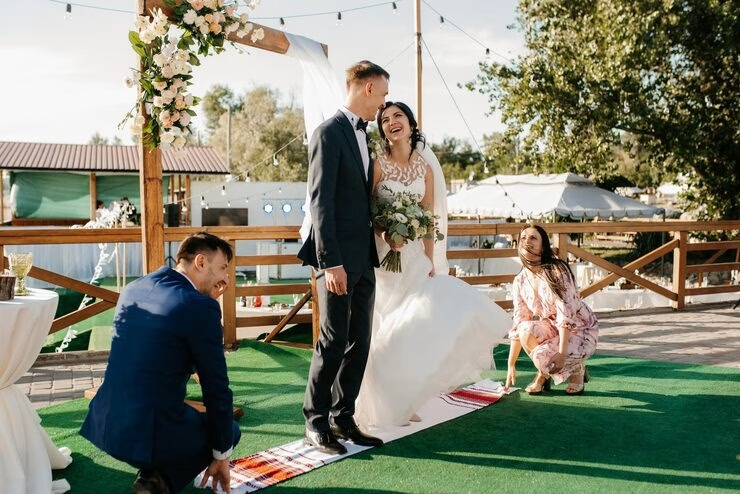
We began planning our wedding—a modest, intimate garden ceremony at a beautiful, small venue in Saratoga. The vision was intentionally simple: nothing extravagant or flashy, just our immediate families and our closest friends gathered under the soft, gentle glow of string lights strung between the old oak trees. Our guest list was small—about a hundred people—mostly comprising Ryan’s steady tech company colleagues and the familiar faces from my accounting firm. It was going to be simple, undeniably beautiful, and entirely ours.
Everything was perfectly arranged, every detail meticulously accounted for.
Until the moment the sleek, white Tesla Model S arrived.
V. The White Tesla and the Impossible Entrance
I was standing near the venue’s main entrance, performing the final, tedious duties of a nervous bride: greeting the last few late arrivals and meticulously adjusting a misplaced boutonniere on my Maid of Honor’s dress. It was in this moment of mundane distraction that I registered the distinct, powerful hum of a high-end electric engine. A white Tesla Model S—a car that screamed status, success, and enormous expense—pulled up to the main gate with a casual, almost arrogant confidence, as if it were the sole, rightful owner of the entire property.
The driver’s door opened with a near-silent swoosh, and out stepped a woman who looked, without exaggeration, like she had just effortlessly walked off the cover of a high-fashion magazine.
She wore a cream-colored Chanel dress, a piece of clothing that I immediately estimated cost more than my entire catering budget. Dark, oversized designer sunglasses shielded her eyes, even against the late afternoon shadows already stretching across the lawn. Her red Louboutin heels, sharp and expensive, clicked rhythmically against the stone pavement. She moved with an aura of impenetrable wealth and absolute, unshakeable confidence that was so potent it made people instinctively turn their heads and stare, their conversations abruptly dying in their throats.
She reached up slowly, deliberately, and with an almost theatrical grace, removed her large sunglasses, her action serving as the formal signal that the performance had begun.
And with that final, slow gesture, my entire meticulously rebuilt world violently tilted on its axis.
Hannah.
This was not the Hannah I had known—the broke, emotionally stressed college friend in thrift store clothes, subsisting on ramen and dreams. This was a completely transformed, different person. She was polished, frighteningly wealthy, and radiated a smooth, impermeable aura of success.
Our eyes locked across the manicured garden lawn. Her mouth curved into a subtle smile—it was neither apologetic nor sheepish, but utterly calm, composed, and unnervingly knowing. Then, she began to walk purposefully, directly toward me.
Time seemed to collapse, moving at a glacial pace. I was distantly aware of Ryan suddenly appearing beside me, his hand instinctively resting on my arm, his voice sounding confused and urgent as he asked if I was okay. But I couldn’t articulate an answer. I couldn’t move. I simply couldn’t process the impossible image of the person standing a few yards away.
Hannah stopped within a few feet of me, maintaining that same infuriatingly serene, knowing smile.
“Congratulations, Amy,” she said softly, her tone entirely conversational, as if we had casually met for coffee just last week instead of being separated by three years of painful, traumatic silence. “Today is truly your special day.”
She extended a thick, cream-colored envelope, its elegance perfectly matching her designer dress.
My hands began to tremble violently as I took the proffered envelope. Ryan was still talking, urgently demanding information. My Maid of Honor hovered nearby, her expression a mix of concern and confusion. The guests continued to whisper, their curiosity overcoming all sense of propriety. But my focus remained laser-sharp: the unexpected weight of that envelope and Hannah’s calm, completely unreadable expression.
With fingers that shook uncontrollably, I managed to break the seal and open the envelope. The curious faces of my wedding guests instantly formed a tight, focused semicircle around the unfolding drama.
Inside, I found a single sheet of paper, neatly folded. My initial, frantic thought was that it was a letter—a desperate, overdue apology, perhaps, or a detailed, plausible explanation for her three years of silence and theft.
But it was not a letter.
It was a bank statement, freshly printed that very morning, clearly showing a completed digital transfer of the precise amount of $8,000.00 into my personal savings account. The transaction’s timestamp was 7:43 AM—just hours before the ceremony. The reference field contained two stark, bold words: “Wedding gift.”
And beneath the cold, banking data, written in Hannah’s familiar, precise handwriting, were two more devastating sentences:
“Paid back with interest. And you… owe me an apology. – H.”
VI. The Accounting of the Apology
The words blurred and swam before my eyes: Paid back. Apology. The entire sequence of events—the dramatic arrival, the expensive car, the unexpected financial repayment—collided into a single, nonsensical blur.
My head snapped up, my gaze locking onto Hannah’s face, confusion, anger, and a renewed, sharp sting of hurt warring in my expression. “What in God’s name are you talking about? You simply vanished. You took my entire savings and disappeared without a trace for three years!”
Her composure remained absolute; her smile never wavered. “I absolutely disappeared,” she conceded calmly. “But I assure you, I didn’t take anything from you that wasn’t freely given. And I certainly never lied to you about the emergency.”
“You asked for the money specifically to handle a family emergency and a collapsing roof, and then you ghosted me!” I countered, the accusation burning in my throat.
“I asked for money to fix the roof,” Hannah corrected me, her tone dispassionate, like a meticulous attorney correcting a flawed witness statement. “And I did hire a contractor and get it fixed for my mother. Then, I immediately moved to Los Angeles to seize a life-changing job opportunity I absolutely could not afford to pass up. A true fresh start in a brand-new city. I am sorry that I didn’t stay in touch, Amy, but I never once promised you that I would.”
“You explicitly promised to pay me back within the year!” I stated, my voice tight with the memory of the promise.
“And I have fulfilled that promise,” she replied with a finality that brooked no argument. “With precisely three years’ worth of accrued interest, actually.” She gestured deliberately toward the bank statement I still held in my trembling hand. “Feel free to check your account balance right now if you doubt the honesty of my transaction.”
I felt trapped in a bewildering nightmare where all logic and reason had failed. “Why this? Why now? Why deliberately show up at my wedding after three years of absolute silence? What is the purpose of this cruelty?”
Hannah’s serene expression finally cracked, shifting subtly. Something harder, colder, and intensely focused crept into her polite, social smile. “Because I genuinely thought you deserved to know the full truth, Amy. The truth about a great many things that have been carefully hidden from you.”
Her eyes momentarily left mine, drifting purposefully toward Ryan, who was still standing silent and utterly pale beside me.
“Hello, Ryan,” she said, her voice dropping slightly, losing the conversational ease, becoming weighted with history. “It has certainly been a very, very long while.”
My entire world stopped spinning. Time achieved a complete, agonizing freeze. In that suspended, terrible instant, I watched my fiancé’s face—the face I had kissed tenderly that very morning, the face I had planned to wake up next to every single day for the rest of my life—drain of every last drop of color, moving rapidly from merely pale to a dreadful, unmistakable shade of ashen defeat.
“You… you know each other?” I heard the distant, thin sound of my own voice, incapable of accepting the reality it was being forced to articulate.
Ryan’s mouth opened, then snapped shut again, utterly devoid of sound. He swallowed painfully, his eyes darting frantically between my shattered expression and Hannah’s cold, triumphant gaze. “Amy, I—”
“We dated,” Hannah announced simply, cutting off his pathetic, failed attempt to speak. The single sentence hung in the air, heavy and decisive. “For two years, actually. Before you and I even became friends. We were briefly engaged.”
The envelope, containing the proof of both the financial debt and the emotional betrayal, slipped irrevocably from my fingers. I barely registered its fall to the lawn.
“Ryan Carter and I were together consistently from our junior year of college until about six months before you and I graduated,” Hannah continued, her voice now utterly conversational, discussing ancient history with unnerving calm. “We lived together in Santa Monica. We talked about marriage, about children, the whole future—everything you and I were planning. And then, he made a decision. He decided he wanted something utterly different. Someone fundamentally different.”
She pinned Ryan with a look that was not the raw fury of anger, but the cold, deep disappointment of unforgiveness. “Someone, as he clearly stated, who wouldn’t challenge him quite so much. Someone easier.”
“That’s not the whole story—” Ryan stammered, but his voice abruptly failed him when he met the burning accusation in my eyes.
“Is this true, Ryan?” I asked him, my voice barely a strained whisper, yet carrying the cutting weight of an absolute final judgment.
The profound, agonizing silence that followed was, in itself, the devastating, complete answer.
VII. The Sickening Clarity of Shared Secrets
“You told me you’d only ever had one serious relationship before me,” I articulated slowly, the fragments of old conversations echoing in the cavern of my mind. Each recalled piece clicked into its proper place, not with the neat satisfaction of an accountant’s audit, but with the sickening clunk of an emotional trap snapping shut. “You emphasized that it had ended badly, and that you didn’t want to ever talk about the details.”
“That specific statement remains factually true,” Ryan insisted weakly, his eyes darting, searching for an anchor in the rapidly swirling storm.
“But you conveniently omitted my name?” Hannah interjected, her voice carrying a note of detached amusement, as if observing a poorly constructed play. “How utterly convenient for your new narrative. And you, Amy, you never bothered to tell him the full name of your cherished best friend from college, did you? Always just ‘Hannah.’ Never the defining surname, ‘Hannah Clarke.’”
She was brutally, painfully correct. In my casual conversations with Ryan, she was simply Hannah, H, my college bestie. Ryan, in turn, had vaguely referred to his traumatic ex simply as his college girlfriend, nothing more specific. We had both been unconsciously protecting old, festering wounds, never realizing, in our mutual negligence, that those wounds belonged to the exact same, devastating history.
“When I finally reached out and asked you for the money, Amy,” Hannah continued, her tone regaining a serious, measured weight, “I need you to believe that I genuinely and urgently needed it for my family. The collapsing roof, my father’s complex medical bills—all of that was tragically, factually true, and it terrified me.”
She paused, taking a breath that seemed to gather the courage of three years. “But I will also admit, without reservation, that I was simultaneously running from an all-consuming, profound heartbreak. Packing up my life and moving to Portland, to that quaint boutique job, felt like the only viable escape—a necessary amputation of the life I had built with him.”
She allowed herself a brief, charged glance at Ryan. “What I didn’t know, what I couldn’t have possibly known in my heartbroken state, was that he had already moved on and found someone new. Someone who, ironically, worked in the same sterile high-rise building as his company. Someone who just happened to be connected to his coworker’s social circle.”
The final, devastating pieces of the puzzle were now falling into place with terrifying, inevitable speed, constructing a chronological picture I wanted desperately to unsee.
“You met him a mere two months after Ryan and I definitively broke up,” Hannah stated, looking at me, her expression a challenge. “At that birthday party Jason threw, right? The big one in San Jose?”
I could only manage a slow, hollow nod. The memory of that happy, safe evening was now contaminated, poisoned.
“I had moved to Portland approximately three months before that evening,” she continued, her narrative unfolding with clinical precision. “I was broken-hearted, financially ruined, struggling to rebuild my shattered self-worth. Then came the family crisis: my dad became gravely sick, the literal roof caved in on our security, and I was forced to make an impossible choice between maintaining my pride and ensuring my family’s immediate survival. I chose survival. And I called my best friend in the world and asked for her unconditional help.”
“And I freely gave it to you,” I whispered, the simplicity of the action now feeling like the setup for a cruel cosmic joke.
“You did, Amy,” Hannah agreed, her voice momentarily softening with genuine respect. “Immediately. Without a single moment of hesitation or questioning. That defining impulse—that immediate, unconditional generosity—that is the purest core of who you truly are, Amy. That is the fundamental reason our friendship was so strong, so sacred. You are genuinely, profoundly good.”
She then turned her gaze back to Ryan, and the brief moment of warmth evaporated. Her voice hardened, becoming cold and surgical. “But then, months later—long after the roof was fixed and I’d started building my new life—I discovered the truth through mutual, oblivious college friends. They mentioned that Ryan Carter, my ex-fiancé, was not only dating someone new, but someone serious. Someone in the financial world. Someone named Amy who worked in accounting in the city.”
A sudden, sharp wave of dizziness washed over me. I stepped back further from Ryan.
“I did the necessary, obvious math,” Hannah said, the accountant’s logic in her tone cutting me deeply. “Same geographical city, same narrow timeframe, same highly specific profession. I used the tiny window I still had—back when I still maintained a public Facebook account—and searched. And there were the photographs of you two, all smiles and future plans, together. And there he was. The man who had ruthlessly broken my heart. Now standing right beside my best friend.”
“You didn’t know it was me,” I said again, this time realizing the defense was not for her, but for myself—a plea for my own innocence in the betrayal.
“Neither did you,” Hannah immediately retorted, the truth in her statement hitting me with the force of a physical blow. “And that, precisely, is what made the pain so exquisite and unbearable. You weren’t intentionally stealing him from me. You were simply living your life, navigating the world, meeting someone new, falling innocently in love. And Ryan? Ryan chose to hide the truth from you because—well, why would he ever reveal it? It was infinitely easier to keep the past firmly buried in the past.”
She looked at Ryan one final time, and the emotion in her eyes was startlingly close to pity. “Except the past, Ryan, has an inevitable, infuriating way of always showing up eventually, demanding its final due.”
VIII. The Concrete Ledger of Debt and Guilt
“The $8,000,” I managed to say, desperately grasping for the concrete, the factual, the numbers that still made sense in this collapsing emotional reality. “You truly did pay it back, just as you promised.”
“This morning,” Hannah confirmed, nodding curtly. “With three years’ worth of interest compounded. The funds are all there, sitting securely in your account. The ledger is finally balanced.”
“But the timing, Hannah! Why now? Why choose this precise, catastrophic moment—my wedding day—to show up and reveal this crushing truth?”
Hannah’s gaze finally softened, a subtle shift in her hard exterior. “Because you deserved to know the full, unvarnished truth before you signed the marriage license. Because I’ve spent the last three years obsessively rebuilding my life in Los Angeles—establishing a successful, financially stable career, and, most importantly, spending countless hours in therapy working through the deep-seated issues left by that heartbreak. And one of the largest, most corrosive issues I had to face was the consuming guilt over what I did to you.”
“Guilt?” The word felt alien, unexpected.
“For disappearing on you completely without a single, truthful explanation. For knowingly allowing you to carry the profound burden of believing I had stolen from you—a belief that negated our entire history—when I had always, always planned to repay the loan. And yes, Amy, for not being emotionally brave enough, in those initial months, to simply tell you that the seemingly perfect man you were falling in love with was the exact same man who had thoroughly demolished my heart.”
She bent slowly, retrieving the cream-colored envelope from the lawn where I had dropped it, and held it out to me one final time—a symbolic transfer of burden. “I have paid my debt in full. All of it. The financial debt is settled, and the emotional debt of my silence is now lifted. Now, Amy, you must decide what you choose to do with this terrible information.”
Hannah’s eyes flickered to Ryan one last time, a farewell to a shared, failed past, then returned entirely to me. “I am not here today to actively ruin your wedding, nor am I here to steal the man who discarded me. I am here purely to give you the most expensive, necessary gift: the truth. What you choose to construct or demolish with this gift is entirely your sovereign choice.”
She pivoted decisively and started walking away, her elegant, confident silhouette heading toward the pristine white Tesla. Her red Louboutins clicked against the pavement, their rhythm sounding like the inexorable countdown of a bomb that had just exploded.
“Hannah!” I called out, the sound ripped from a place of profound confusion and sudden realization.
She paused, turning her head back, waiting.
“Why did you write on the bank slip that I owe you an apology?”
She smiled sadly, a heartbreaking, wistful expression. “Because, Amy, somewhere deep in your heart, you ultimately believed that I was capable of stealing from you and disappearing forever. You concluded, perhaps justifiably, that our shared six years of friendship meant so little to me that I would take your life savings and vanish without a single word of remorse. And yes, I should have absolutely communicated my situation better, should have explained clearly where I was going and why I was leaving. But Amy—you never once considered the possibility that I might have a genuinely good, devastating reason for my silence. You never picked up the phone and tried hard enough to find me in the real world. You simply… assumed the worst of the person who had loved you most deeply.”
The words struck me with the unexpected, searing impact of a physical slap, yet I recognized them as utterly true. I had assumed. I had given up the search. I had summarily written her off as a cynical con artist, a selfish user, a fake friend unworthy of the trust I had extended. The shame of my own lack of enduring faith was suffocating.
“I’m sorry,” I whispered, the two words finally emerging, stripped of pride or defense.
Hannah nodded gently. “I know you are. And I forgive you for that doubt. But Amy, you still have a far more important task ahead of you: you need to figure out if you can possibly forgive him.”
She slid gracefully into the Tesla and drove away, leaving behind a profound silence, a wedding full of utterly confused, whispering guests, a groom who looked dangerously close to a nervous collapse, and a bride standing alone, holding a returned bank statement that felt heavier and more real than any diamond or bouquet ever could.
IX. The Post-Ceremony Negotiation of Trust
The remainder of what was supposed to be the happiest day of my life passed in a dissociative, dreadful blur. I mechanically went through the required motions—reciting the sacred vows, exchanging the rings, navigating the awkward first dance, and smiling stiffly for the cake cutting photos. Every single guest in the garden could feel the oppressive, glacial tension vibrating between Ryan and me. Guests whispered behind cupped hands. Ryan’s parents looked deeply, tragically concerned. My Maid of Honor kept hovering, her eyes wide, constantly asking if I was “okay.”
I nodded, I smiled, I gave all the socially expected, polite responses, but inside, I was utterly, profoundly hollowed out. The center of my life, the stable foundation I thought I had secured, had just been vaporized.
That night, in the overly opulent honeymoon suite we had booked at a nearby five-star hotel, Ryan and I finally confronted the ruins of our relationship.
“I should have told you immediately,” he repeated, sitting miserably on the edge of the vast, white bed while I stood immobile by the window, still encased in the heavy, suffocating white wedding dress. “The second I realized Hannah was your college friend, I should have said the full, unvarnished truth.”
“When precisely was that moment of realization?” I asked, my tone precise, demanded by the accountant in me who needed dates and facts.
“About six months into our relationship,” he confessed, his voice heavy with self-loathing. “You showed me an old group photograph from college—a fun shot of you, Hannah, and a few other friends. I recognized her instantly.”
“And you chose to say absolutely nothing.”
“I rationalized it away. I told myself it simply didn’t matter. That the past was truly past. That burdening you with the complication would only make you leave me. I panicked.”
I turned, my gaze piercing his evasion. “You let me talk openly about my friend who had violently disappeared, the one I truly believed had stolen every dollar I owned. You listened sympathetically to me stress, to my anguish over the money, over the sheer magnitude of the betrayal. And the entire time, Ryan, you knew exactly where she was, what she was doing, and exactly why she had left town so abruptly.”
“I didn’t know the full extent of why she had left—that it was specifically because of me,” Ryan weakly protested, his hands kneading his trousers. “Not at first. I genuinely thought the timing was a coincidence.”
“But you strongly suspected.”
The silence that followed stretched, long and devastating, confirming my accusation.
“Did you genuinely love her?” I asked, forcing the core question into the space between us.
Ryan stared miserably down at his own trembling hands. “Yes. I did. Once, a long time ago. But that relationship had ended badly, violently. We simply weren’t right for each other; too much fighting, too many fundamental differences. When I met you, Amy, it felt like an undeniable second chance—a true fresh start with someone completely… compatible.”
“Someone easier,” I stated flatly, repeating the cruel judgment Hannah had delivered.
He winced visibly, but this time, he did not offer a denial.
I finally walked toward the chairs in the corner, sinking down into one, suddenly too physically and emotionally exhausted to stand a moment longer. “The $8,000 appeared in my account this morning, exactly as Hannah promised, plus interest she was under no legal obligation to pay.”
“I know,” Ryan whispered. “I saw the transaction notification pop up on my phone, too.”
“You knew she was planning to pay me back eventually?”
“No,” Ryan said quickly, defensively. “I had absolutely no idea. I haven’t exchanged a single word with Hannah since we broke up three years ago. Today, at the wedding, was the first time I’d laid eyes on her since then.”
I believed him on this point. But the truth of the loan was a detail; the truth of the betrayal was a chasm.
“I need time, Ryan,” I said finally, my voice regaining a core of steely resolve. “I need space to process this entire annihilation.”
“We just got married, Amy,” he pleaded, his voice cracking with fear. “Please, we can fix this, we can try to—”
“I know precisely what we just did,” I interrupted, cutting him off cleanly. “But I cannot pretend that everything is remotely fine just because we have rings on our fingers and a hotel reservation. I cannot simply transition into a marriage built on deliberate lies.”
X. The Decision to Fight with Open Eyes
I spent the entirety of that wedding night alone in the expensive hotel room. Ryan left the room without argument, driving away silently toward his apartment—our apartment, now—while I sat frozen, still clad in a ludicrously expensive white dress, desperately trying to construct logic from the rubble of my life.
By the first light of dawn, sitting by the window and watching the city awaken, I had forged a definitive decision.
I was not going to walk away from Ryan immediately. Not yet. But I was certainly not going to pretend that the entire foundation of our relationship had not been completely poisoned.
When I finally arrived home hours later, Ryan was already in the kitchen, meticulously making coffee, his eyes betraying his lack of sleep, red and puffy from the long, agonizing night.
“We need therapy,” I announced without preamble, my voice flat and non-negotiable. “Couples counseling. We start this week, immediately.”
He looked up, a wave of desperate hope and relief flooding his ravaged face. “Yes, Amy. Absolutely. Whatever you need, I will do.”
“And you need to commit to being absolutely, completely honest with me from this moment forward,” I continued, listing the terms of my precarious conditional pardon. “About everything, Ryan. No more secrets, no more convenient omissions, no more selective memory.”
“I promise you that, Amy.”
“I mean it, Ryan. One more lie—even a small, trivial one—and I am definitively finished with this marriage.”
“I understand completely.”
I poured myself a cup of the strong, bitter coffee, my hands surprisingly steady. “Hannah paid me back every cent. She kept her solemn promise. And she also gave me an even greater, painful gift: the truth—a truth neither you nor I were brave enough to confront on our own.”
Ryan flinched, but remained silent, accepting the statement as fact.
“I am intensely angry,” I continued, allowing the emotion to surface briefly. “At you, for the deception. At Hannah, for the dramatic, manipulative way she chose to deliver the truth. And yes, at myself, for not asking the right, hard questions over the past three years. But I am also, bizarrely, grateful. Because if I am truly going to build a life with you, Ryan, it must be built solely on truth. Not on manufactured convenience, not on assumed comfort, but on the painful, fundamental truth of who we both are and where we came from.”
“I want that truth too, Amy,” Ryan said softly, finally meeting my gaze with genuine sincerity.
“Then we will both work for it, every single day. Together. And if, in the end, it turns out we simply can’t make this marriage work, at least we will know, unequivocally, that we tried to save it honestly.”
He nodded, a gesture of submission and commitment. And for the very first time since Hannah’s white Tesla had pulled up to the venue, I felt the suffocating constriction in my chest release. I could finally, tentatively breathe again.
XI. The Long Journey to Reconciliation
A full year passed under the shadow of Hannah’s revelation. The counseling sessions became a regular, necessary ritual. Ryan and I painstakingly worked through the intricate knots of his initial betrayal, the layered lies of omission, and the complicated, tangled history that had unexpectedly connected our three lives. Some days were an exhausting battle. Some nights, lying awake in the dark, I still found myself obsessively replaying Hannah’s cutting final words: “And you owe me an apology.”
She had been profoundly right. I had allowed my immediate pain and financial panic to override six years of deep, unwavering friendship. I had automatically assumed the worst of a person who, until that moment, had been nothing but generous and loyal to me. I had allowed suspicion to decisively override history.
On the one-year anniversary of our profoundly messed-up wedding, I took a decisive action I had been contemplating for months, a final effort to settle the emotional score.
I composed a letter to Hannah. A physical letter, on heavy, tactile paper, carefully mailed to an address I had painstakingly tracked down through a network of old, mutual college friends.
Dear Hannah,
You were absolutely right. I owe you a sincere apology—a genuine one, far more substantial than the few whispered words I gave you during the chaos of my wedding.
I am profoundly sorry for immediately assuming you had stolen from me. I am sorry for not trying harder, in those frantic first weeks, to truly understand where you had gone and the deeper reasons why you felt compelled to leave. I am most sorry for believing the worst possible scenario instead of clinging to the memory of the best person you had been to me for years.
You were my friend—my absolute best friend—for six formative years. That history, that loyalty, earned far better than my subsequent doubt and immediate judgment.
The $8,000 you returned to my account remains untouched in a separate savings account. I am choosing to treat it, retroactively, as what it always should have been: a profound, freely given gift between two close friends, granted without any expectation of eventual return.
Ryan and I are currently, arduously, working on our marriage. It is incredibly difficult, but we are committed to trying honestly. The painful truth you delivered at my wedding, while brutal, was undeniably necessary. You provided me with the chance to finally choose him with my eyes completely open, fully cognizant of the challenging history our relationship contained.
I honestly don’t know if you desire to hear from me ever again. I would not blame you in the slightest if you chose not to respond. But if you ever feel the need to talk—to truly talk, not just show up at life events with calculated, dramatic revelations—I want you to know that I am genuinely here to listen.
You will always remain the most important friend from college. The one who could somehow make bad, cheap dorm room ramen taste like a gourmet meal. The one who intimately knew all my secrets and fears. The one who, against all odds and my own expectations, came back to return exactly what she had borrowed, even though I had already painfully, officially written it off as a complete loss.
Thank you, Hannah, for keeping your promise, even during the long period when I had entirely stopped believing in your capacity to do so.
With enduring love, and genuine regret,
Amy
XII. An Open Door and a New Foundation
Three agonizing weeks later, I received a response. It wasn’t a formal, written letter—it was a single, simple Instagram notification. Hannah had created an entirely new, public account, and sent me a follow request.
Her new profile biography was succinct, a clear declaration of her current focus: “Starting over, for real this time.”
I immediately accepted the request.
We did not instantaneously revert to being best friends, trading daily gossip and planning elaborate weekend trips. Perhaps we never would regain the naive, absolute intimacy of those college years. But we began to talk again—tentatively, carefully, and with a raw, painful honesty about what had transpired between us and what essential lessons we had both been forced to learn from the collateral damage.
She confided in me the details of her life in LA—the successful trajectory of her work in high-stakes tech sales, and the intense therapy that had ultimately helped her reconstruct her self-identity after her heartbreak and the subsequent shame of betraying my trust. I, in turn, shared the grueling realities of couples counseling, the daily, difficult work of learning to rebuild my faith in Ryan, and the slow, arduous process of attempting to repair a marriage that had nearly shattered before it had officially begun.
The relationship was demonstrably not what it used to be. It was mature, cautious, and deeply flawed. But it was undeniably something. And sometimes, in the difficult, messy landscape of adult life, that genuine, fragile something is more than enough.
XIII. The Most Expensive, Necessary Gift
People sometimes ask me, especially when discussing milestones, what the most memorable, vivid part of my wedding day truly was. Was it the flowing dress? The beautiful garden venue? The emotional exchange of the formal vows?
I always deliberately pause before offering my sincere, honest answer.
The most intensely memorable, life-altering part was the single moment Hannah handed me that cream-colored envelope. Not simply because of the significant amount of money involved—though $8,000, even returned, holds financial weight—but because of the profound, brutal truth that package contained.
Truth. It was delivered at the absolute worst, most inconvenient possible moment, in the most highly dramatic and calculated fashion imaginable, by the one friend I had definitively believed was gone forever.
That night, sitting alone in the expensive honeymoon suite, still encased in my wedding dress while my brand-new husband drove away to face his shame, I absorbed a truly invaluable, life-defining lesson:
Sometimes, the most expensive, transformative gifts are not sweetly wrapped in ribbon or tied with paper. Sometimes, they arrive in the form of brutally uncomfortable truths that violently force you to re-examine every aspect of your life—your choices, your most closely held assumptions about the people you love, and the core of your own personal integrity.
Hannah gave me back my money, thereby clearing her financial and moral debt to me. But far more importantly, she gave me the devastating truth about my husband, about her own complicated actions, and most painfully, about me—about my innate, swift capacity to assume the absolute worst and my failure to provide enduring trust to the one friend who had most genuinely earned it.
That painful truth was an agonizing shock to my system. But it was absolutely, unequivocally necessary.
And in the long run, I now recognize that truth as the single greatest wedding gift I could have possibly received—even if the realization took many months of pain and work to fully sink in.
Ryan and I remain married. We are still actively, deliberately working on the marriage, committed to the daily, slow process of repair. Some days are filled with genuine connection and hope. Some days remain acutely difficult and marked by the shadow of doubt. But we are continuing to try, honestly, with every single card now laid transparently on the table.
And Hannah? She is continuing to build her life in Los Angeles, successfully single and thriving in her ambitious career. We maintain occasional contact—it is mostly surface level, professional, but beneath the polite small talk, there remains the palpable, enduring hint of the deeper, resilient friendship we once shared.
Maybe, someday, we will genuinely get back to that place of absolute trust. Maybe we won’t.
But I will carry the profound realization forever: I will always be grateful that she showed up at my wedding in that elegant, cream Chanel dress and those striking red Louboutins, holding that single, pivotal envelope that changed every single thing.
Because sometimes, the simple, unvarnished truth is worth more than any quantifiable amount of money.
Even if its delivery costs you everything you thought you knew about your life.
THE END
Trending Right Now:
- My Mother-in-Law Tried On My Wedding Dress and Destroyed It — So I Made Her Regret It Publicly
- He Cheated. She Laughed. I Served Them Both a Slideshow of Karma
- “I Overheard My Husband and Our Neighbor’s Daughter — So I Came Up With a Plan She Never Saw Coming”
- He Couldn’t Move, But He Knew Something Was Wrong — So He Looked Up
- I Gave a Ride to a Homeless Man — The Next Morning, Black SUVs Surrounded My Home
- I Married My Former Teacher — But Our Wedding Night Revealed a Secret I Never Saw Coming


Leave a Comment