
💛 The Return of the Lost Thread: A Kindness That Built a Home
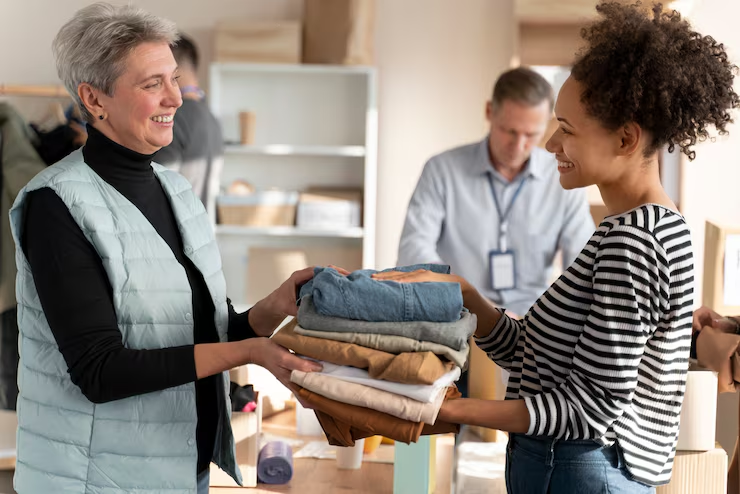
Last year, when I finally forced myself to pack away my daughter Maya’s smallest dresses and outgrown sweaters, preparing to post them online to give away for free, I genuinely believed I was engaging in a purely mundane act of decluttering. It was nothing more than another tick-mark on the relentless, endless domestic to-do list, another small, desperate attempt to reimpose a semblance of order onto a life that had become increasingly turbulent and overwhelmingly chaotic.
I was running on fumes, deeply and fundamentally exhausted. My grief was still raw and debilitating; my mother had passed away only three months earlier, leaving a massive, palpable void. Simultaneously, I was grappling with a demanding, high-pressure job that possessed no capacity or patience for my personal sorrow. My primary focus was trying to keep life feeling steady and normal for Maya, my sharp, perceptive five-year-old daughter, who was now asking the difficult, elemental questions that, honestly, I didn’t know how to answer. Questions that cut right to the heart of the matter, like, “Where did Grandma go, Mommy?” and the agonizing, accusatory, “Why are you always sad now, Mommy?”
The clothing boxes had been sitting untouched, guiltily tucked away in the deepest corner of Maya’s closet for months. The garments themselves were too small for her now, outgrown in that sudden, bewildering way children have of transforming overnight from dependent babies into articulate, independent little people. I had been meaning to address the contents of those boxes since the early spring, but every single time I opened one, I would find myself paralyzed. I would hold the tiny dresses against my chest, the soft fabric triggering a rush of visceral memory: Maya wearing that specific outfit, the way she smelled, and, most painful of all, the expression on my mother’s face when she had first seen her granddaughter bundled up in the thick pink sweater she had meticulously knitted herself.
But on that particular, quiet Saturday morning, with a grim resolution, I forced myself to start. Maya was thankfully at her father’s house for the weekend. We had been divorced for two years now, managing a civil, structured co-parenting arrangement that functioned with far greater stability and communication than our actual marriage ever had. The resulting empty silence of the apartment was oppressive, echoing with ghosts of memories and the weight of countless unfinished tasks.
So I pulled the boxes out and began the arduous process of sorting. There were heavy winter coats that still carried a faint, residual scent of Maya’s baby shampoo. Corduroy overalls with permanent, evidence-based muddy knees from countless hours spent in the park sandbox. And then there were my mother’s hand-knitted sweaters in soft, gentle pastels, each perfectly formed stitch a testament to a true labor of love, created despite the persistent, crippling ache in her arthritic hands that had simply refused to cease creating beauty until the very end.
I carefully photographed the resulting pile of clothes—a mound of warm, colorful fabric—and posted the image to a local parent exchange group online. My message was brief and to the point: Free children’s clothes, size 3T-4T. Winter items, some handmade. Pick up or can ship if you cover postage.
Within the hour, the replies began to flood my inbox—a dozen responses. Most were utterly generic: “Still available?” or the simple, non-committal, “I’ll take them. Let me know.” But one particular message, buried in the digital clutter, was profoundly different.
✉️ Nura’s Vulnerability: The Plea for Dignity
The message was from a user named Nura:
Hi. I saw your post about the children’s clothes. I know you probably have lots of people asking, but I wanted to reach out anyway. Money is very, very tight right now, and my daughter desperately needs warm clothes for the coming winter. She just turned four, and she’s growing so incredibly fast, I can barely keep up with her needs. I can’t afford to cover the postage right now, but I promise you with all my heart I’ll pay when I’m able to get back on my feet. I understand completely if you need to give them to someone else who can manage the payment. Thank you so much for even offering them in the first place.
I sat and stared at the screen for a long, quiet time. Something profound in her words arrested my scrolling finger and tugged relentlessly at my chest—the carefully constructed politeness despite her desperate need, the raw, agonizing vulnerability of admitting she could not afford a trivial shipping fee, the firm, yet heartbreaking promise to pay “when able” that suggested she was a person of profound honor, someone who respected and kept her debts even when her circumstances made it seem nearly impossible.
I felt the almost irresistible urge to scroll past and forget. I had enough overwhelming weight on my own plate; I truly did not need to consciously take on the additional burden of a stranger’s overwhelming struggles. I could easily, effortlessly, give the clothes to one of the other dozen people who had responded—people who could pay the shipping instantly, people who wouldn’t require me to extend such a precarious, emotional degree of trust to a complete stranger.
But then, the image of my mother intervened. I kept thinking about the core of her being—the kind of person she had fundamentally been, always the first to offer practical, substantial help when someone was truly in need. I thought of the handmade sweaters resting in that box, knitted with her gnarled, loving fingers and fierce, protective love. What, in that precise moment, would she want me to do?
I felt a decisive shift in my spirit. I typed out a response swiftly, before the rational, protective part of my brain could overthink the risk or the cost:
The clothes are entirely yours. Send me your address immediately. I’ll cover the shipping cost completely. There is absolutely no need to pay me back—just pay it forward when you are stable enough to do so.
Her reply was almost instantaneous, laden with surprise and caution: Are you completely sure? I don’t want to feel like I’m taking advantage. I will pay you back, I absolutely promise.
My final message was simple and definitive: I’m sure. Just send your address.
📦 The Abundance of Care: Packing the Box
Two days later, with a renewed sense of purpose that transcended the simple action of charity, I set about packing the box with meticulous care. Into the large carton went Maya’s old winter coat—a sturdy, navy blue number with unique white buttons shaped like snowflakes. The corduroy overalls. Crucially, three of my mother’s exquisitely knitted sweaters. A handful of thick, warm pajamas. Some sturdy, high-quality shoes that had barely been worn because Maya had entered a six-month phase where she adamantly insisted on wearing her sparkly pink sneakers, and only the sparkly pink sneakers, every single day.
I couldn’t stop there. I impulse-added a few children’s books Maya had clearly outgrown, several packs of bright, unused hair ribbons, and a new, warm pair of mittens. My intention was clear and conscious: I wanted whoever received this unexpected box to feel a sense of profound abundance, not the clinical, cold touch of mere charity. I wanted her to feel, definitively, like someone cared enough to think of her.
At the bustling post office, the clerk looked sceptically at the address I had carefully handwritten on the heavy package. “That’s going a pretty far distance,” she commented, raising an eyebrow. “You actually know the recipient?”
“Not yet,” I said, the phrase carrying a new, quiet truth. “But I sincerely hope the clothes help her and her daughter.”
I paid for the shipping—forty-two dollars, a small bite out of my budget but a cost far less than what my conscience would have demanded had I sent the box without proper tracking and insurance. I returned to my car, the act complete, and immediately filed the entire event away, sinking back into the familiar, overwhelming daily demands of work deadlines, Maya’s upcoming school concert, and the persistent, quiet, physical grief that perpetually lived in my chest like a smooth, heavy stone.
Sometimes, we initiate an act of genuine giving without ever realizing the incredible distance that single gesture of kindness might travel. We perform what feel like small, insignificant acts of generosity and immediately move on, never once seeing the full, complex impact, never understanding how a single moment of trust might ripple outward into someone else’s life in profound, beautiful ways we cannot possibly imagine.
🍂 The Quiet Waiting: Kindness Fades into Memory
Autumn gradually surrendered to the full weight of winter. The holidays began to approach, bringing with them their particular, inescapable brand of bittersweet, agonizing pain—Maya’s very first Christmas without her beloved grandmother, the conspicuous empty chair at our small dinner table, the treasured traditions we meticulously tried to maintain even as they felt hollow and terribly muted without my mother’s vibrant presence.
Work intensified as the fiscal year drew to its inevitable close. I actively took on extra projects, partly out of a genuine need for the additional money, but mostly because staying relentlessly busy was the only dependable strategy for minimizing the time available to feel the raw, waiting grief.
Maya, thankfully, was thriving in kindergarten. She was making friends, and learning to read with an almost frantic, infectious enthusiasm that served as my daily, powerful reminder of precisely why I continued to push through the hardest, quietest days. She began to ask about my mother less and less frequently, though sometimes, I would catch her engaging in intense, whispered conversations with empty air, and I would inevitably wonder if she was talking to the fiercely loving grandmother who had vanished from our world.
I briefly attempted to date—a kind, quiet man from my office who took me out for dinner and managed to make me laugh, but who ultimately needed a level of emotional availability that I simply could not yet give. We separated amicably, and I consciously redirected my focus back onto the small, safe circle of my own life: Maya, work, and the few close friends who fully understood that I was doing my absolute best with the deeply limited resources I currently possessed.
The memory of the box of clothes, and the woman who had desperately needed them, slowly faded from my conscious thoughts entirely. It was filed away under a closed mental ledger titled: “Good deed done, emotional obligation met, moving on.” I had absolutely no reason to think about it, or them, ever again.
Until nearly a year later, when a completely unexpected parcel showed up on my doorstep.
📦 A Circle Completed: The Return of Gratitude
It was a quiet Saturday morning in September, almost exactly eleven months after I had stood at the post office and shipped that care package. Maya and I were in the middle of breakfast—pancakes shaped like various zoo animals, a weekend ritual I maintained to make our mornings feel distinct and special—when the doorbell rang with a sharp, insistent sound.
“I’ll get it!” Maya shrieked, instantly scrambling off her chair and running toward the door before I could possibly stop her.
“Look through the peephole first, please!” I called, following her down the hallway.
“It’s just the mailman, Mommy. He’s leaving a big box.”
I opened the door just as the postal carrier was walking back to his truck. A sturdy, medium-sized package sat squarely on the doormat, my name and apartment address written in neat, careful, unmistakable handwriting.
There was no return address anywhere on the label. Only a clear postmark from a distant city I had certainly never visited or heard of.
“What is it, Mommy?” Maya asked, bouncing excitedly on the balls of her feet, possessing the raw, unadulterated excitement children bring to the arrival of any package.
“I don’t know, sweetie. Let’s find out together.”
We carried the box inside, and I used scissors to carefully cut through the industrial tape. Inside the shipping carton was another, smaller box, this one lovingly wrapped in cheerful paper covered with bright, vibrant flowers. A single, plain card rested on top of the inner box.
I opened the card first. The handwriting was precisely the same as the one on the shipping label—neat, careful, feminine, and profoundly familiar.
Dear Sarah,
*Nearly a year ago, you did the most extraordinary thing: you sent me a large box of clothes for my daughter when I truly had nothing. You didn’t know me from anyone. You had absolutely no tangible reason to trust me. But you chose to help anyway, and I need you to know that your single act of kindness reached me in my darkest, most frightening time.
Those clothes, Sarah, carried my little girl through the coldest winter of our lives. They physically kept her warm when I simply could not afford to turn up the heat in our tiny apartment. They made her feel beautiful and cared for when everything else in her unstable world was scary and deeply uncertain. Every single time I dressed her in one of those incredibly soft sweaters, I thought about the complete stranger who had cared enough to send them to us.
I’ve held onto them all this time, meticulously washing and folding them with the greatest care, waiting until I was strong enough to return them with the profound gratitude they deserve. I am in a far better place now—we both are—and I wanted you to have them back, or to pass them on to another family who might desperately need them.
“Thank you” doesn’t feel powerful enough to encompass what you did, but it is all I currently have. Thank you for seeing me when I was invisible. Thank you for trusting me when you had zero reason to. Thank you for showing my daughter, Amira, that there are genuinely good people in the world who care.
With deep and everlasting gratitude, Nura
My eyes were already blurring with hot tears as I set the handwritten card down and gently unwrapped the inner box. Inside were the clothes—every single piece I had sent, freshly washed, pressed, and folded with meticulous, loving care. The navy coat with the white snowflake buttons. The corduroy overalls. My mother’s sweaters, each one perfectly folded just so.
And then, underneath everything, carefully nestled in a bed of white tissue paper, was something small, yellow, and profoundly familiar that made my breath catch violently in my throat.
A small, crocheted yellow duck.
🐣 The Lost Treasure: A Reminder of Enduring Love
I lifted the small object with trembling hands, staring at the crocheted toy in absolute disbelief. “Oh my god,” I managed to whisper, the sound barely audible.
“What’s that, Mommy?” Maya, fascinated, leaned over the box to look closer. “Is that a little duck?”
“It’s… it was mine,” I said, my voice completely breaking with emotion. “When I was very little. My grandmother made it for me.”
I had completely, utterly forgotten the duck existed. It had been decades since I’d last seen it, lost somewhere in the chaotic aftermath of childhood moves, the turbulence of growing up, and the eventual, necessary packing away of my own childhood belongings when I had moved out of my parents’ house so many years ago.
The little yellow duck, hand-crocheted by my grandmother who had tragically died when I was only twelve, must have been accidentally tucked into one of the boxes I had brought home after my mother’s death. Mixed in unintentionally with Maya’s baby clothes somehow. Sent away with the donation without me ever realizing the priceless treasure that had been included.
And now, miraculously, it was back.
I sank down hard onto the couch, instantly collapsing, clutching the worn, soft yellow duck fiercely to my chest, and began to cry in earnest. It was not the quiet, manageable stream of tears I had grown accustomed to over the past year; these were deep, primal, body-shaking sobs that came from a place of unexpected release, gratitude, and healing.
Maya immediately climbed onto the couch beside me, her small hand instinctively patting my arm in comfort. “It’s okay, Mommy. Please don’t be sad.”
“I’m not sad, baby,” I managed to choke out, struggling for breath. “I’m… I’m just so profoundly grateful.”
📞 Reconnecting the Thread: The Phone Call of Thanks
Nura’s thoughtful note had included her phone number at the bottom. I stared at the numbers for a long, quiet time after I had composed myself, after I had managed to make Maya some fresh pancakes, and after I had gently explained that sometimes, grown-ups cry when they are happy, not just when they are heartbroken.
Should I call? Would it be intrusive or awkward to call a stranger just to say thank you for returning an object I hadn’t even known was missing?
But this was no ordinary stranger. This was a woman who had meticulously held onto these items for nearly a year, who had washed and folded them with genuine care, who had somehow possessed the emotional intelligence to recognize that this small, hand-crocheted yellow duck was important enough to travel home.
I dialed the number that very afternoon while Maya was completely absorbed in building an elaborate, complex castle with her blocks in the living room.
The phone rang three deliberate times before a woman answered. “Hello?”
“Hi,” I said, suddenly, surprisingly nervous. “Is this Nura?”
“Yes?” Her voice was cautious, uncertain of the caller.
“This is Sarah. You sent me a box. With clothes and… and a yellow duck.”
“Oh!” Her voice instantly brightened, flooding with warmth. “Oh, Sarah! You got it! I was so worried it wouldn’t arrive safely, or that you’d moved, or—I’m so incredibly glad you got it.”
“The duck,” I repeated, my voice still thick with tears and emotion. “Did you know? Did you have any idea what it actually was?”
“I knew it was important,” she said softly, simply. “My daughter, Amira, found it tucked in the very bottom of the box when we first unpacked everything. She desperately wanted to keep it, but I told her it looked special. Like someone had made it by hand, like it had history and deep meaning. I promised her that, one day, we would make sure to return it.”
“It was my grandmother’s,” I said. “She made it for me when I was a little girl. I thought it was lost forever.”
“I’m so incredibly glad it found its way back to you, Sarah,” Nura said. “After everything you did for us, it felt absolutely essential to me to make sure you got it back.”
“Tell me,” I said, settling deeper into the soft cushions of the couch. “Tell me your story. Please.”
💔 Nura’s Journey: The Power of Dignity
And she did. Nura spoke for well over an hour, and I simply listened. Maya continued to play quietly beside me, and outside the window, the harsh afternoon light slowly softened and turned a golden, peaceful color.
Nura shared her agonizing story: she had been trapped within a marriage that had slowly, insidiously turned dangerous. Small, controlling behaviors had gradually escalated over the years until she found herself completely isolated from friends and family, financially dependent on her husband, and genuinely fearful for both herself and her young daughter.
She had finally found the courage to leave in the middle of the night, taking only a single bag of items she could physically carry, arriving at a safe women’s shelter in a completely new city where she knew not a single soul. The shelter provided crucial safety but little else—she had been forced to start completely over, literally with nothing.
The challenges had been immense: finding work without any available references. Securing an apartment without a documented rental history. Finding reliable childcare she could possibly afford on minimum wage earnings. Buying necessary groceries when every dollar had to be stretched impossibly far. And the hardest task of all: trying to explain to her frightened four-year-old why everything familiar had changed so drastically, why they lived in a tiny, noisy apartment instead of their old house, why Mommy was always so profoundly tired and worried.
Winter had arrived mercilessly early that year, and Nura had faced the terrifying reality that her daughter’s inadequate summer clothes simply wouldn’t be enough. She couldn’t afford a warm coat, couldn’t afford thick pajamas, couldn’t afford the absolute basics that most parents took entirely for granted.
“I was relentlessly searching online every single night,” she confessed. “Looking for free things, for assistance, for anything at all. And then I saw your simple post. And I genuinely almost didn’t message you because I was so consumed by shame. Ashamed that I couldn’t even afford the shipping. Ashamed that I was desperate enough to need charity. But my daughter needed warm clothes more than I needed my pride.”
“When that box arrived, Sarah,” she continued, her voice trembling slightly, “when I opened it and saw how carefully you’d packed everything, how genuinely nice every item was—those weren’t just random hand-me-downs. They were quality clothes. And those sweaters…” She paused, taking a deep breath. “I could instantly tell someone had made them by hand. I could tell they had been woven with genuine love and care.”
She told me how her daughter, Amira, had worn those specific sweaters constantly. How they had instantly become her most treasured possessions, how she would refuse to take them off even for washing. How the navy coat with the snowflake buttons had made her feel like a magical princess, how she would twirl in it and pretend the snowflakes were magic wishing dust.
“You gave my daughter dignity, Sarah,” Nura concluded, her voice thick with emotion. “At a time when we were completely destitute, when I could give her absolutely nothing, you gave her clothes that made her feel special and cherished. And that, truly, mattered more than I can ever possibly explain.”
🤝 Building a New Fabric: From Strangers to Sisters
We spoke again the next day. And the day after that. The initial conversations were short, tentative check-ins, sharing small, cautious updates—the careful, organic beginning of something neither of us had remotely expected.
Nura told me she had secured a better job, that she had been promoted twice in the past year through sheer, uncompromising determination. That she had finally managed to save enough money to move to a safer, better neighborhood. That Amira was thriving in preschool, making friends, and finally laughing fully again.
I shared my own painful journey: the enduring shadow of my mother’s death, the grief that still ambushed me at the quietest, most unexpected moments. I told her about the difficulty of trying to raise Maya alone while managing the demands of work and desperately trying to keep the memory of her grandmother alive. I spoke of the profound loneliness of single parenthood, even when you are financially stable.
“You know,” Nura said during one of these deep, connecting conversations, “I’ve been thinking about this a lot. Would you ever want to meet sometime? I would love for our daughters to finally meet face-to-face.”
I hesitated immediately. Meeting online strangers in person always carried a significant risk, the constant potential for profound disappointment when reality inevitably failed to match expectations.
But then, I thought about the little yellow duck resting safely on my nightstand. About the profound care with which Nura had returned those clothes. About the vulnerability and trust she had shown in sharing her painful, difficult story.
“Yes,” I heard myself say, surprising even myself. “I would absolutely like that.”
👭 The First Thread: Friendship Takes Root
We met at a large, bustling park exactly halfway between our neighborhoods on a bright, sunny Saturday afternoon. I arrived fifteen minutes early, feeling a strange, deep sense of nervousness I hadn’t experienced since middle school, privately wondering if this whole venture was a colossal mistake.
Then I saw her—a small, resolute woman with kind, honest eyes, her daughter’s small hand held firmly in hers. The little girl, Amira, was actually wearing one of my mother’s sweaters, the pale yellow one with the tiny embroidered daisies at the collar.
“Sarah?” Nura called out, and I immediately waved back.
Our daughters sized each other up with the solemn, intense assessment children bring to the possibility of a new friendship. Then Maya, ever direct, said, “Want to go on the swings with me?” and Amira nodded enthusiastically, a bright smile breaking through. Just like that, they were off, two small figures instantly connected.
Nura and I settled onto a nearby bench, watching them play together. “Thank you so much for coming,” she said, her voice genuine. “I really wasn’t sure if you would show.”
“Thank you for reaching out,” I replied. “I’m incredibly glad you did.”
We talked as our daughters played—real, genuine conversation, the kind that naturally builds strong bridges between two people—about the constant struggles of parenting, the relentless stresses of work, and the impossible task of trying to be “enough” when you feel like you are constantly falling short of an invisible mark. We talked about recovery, from vastly different kinds of trauma, and the sheer difficulty of rebuilding a life when everything familiar has been brutally taken away.
“That sweater,” I said finally, gesturing toward Amira. “My mother actually made that one. She died last year.”
“I know,” Nura said softly, looking at the intricate stitching. “I could tell from how meticulously they were made. From the love woven into every stitch. I hope it’s okay that Amira’s wearing it.”
“It’s perfect,” I said, and for the first time, I felt the truth of the words. “My mother would have loved knowing it was keeping someone warm right now.”
🏡 Weaving a New Family: The Unforeseen Gift
That very first meeting seamlessly turned into regular playdates. At first, once a week, then twice, then so incredibly frequently that our daughters started actively asking for each other if more than a few days passed without seeing the other.
Maya and Amira became inseparable. They possessed that instant, magical chemistry some children find, where they just click and are suddenly sharing deeply held secrets, making up elaborate fantasy games, and finishing each other’s complex sentences.
And Nura and I? We became friends too. Real friends, the kind of essential people you immediately call when you’re having an impossible day. The kind you trust with your deepest fears and celebrate your smallest victories with.
We naturally took turns watching each other’s daughters when work ran unexpectedly late. We shared meals—sometimes at my place, sometimes at hers, sometimes potluck style where we’d each bring something different and the girls would gleefully help “cook,” making wonderful messes and lasting memories in equal measure.
Nura taught me invaluable lessons about resilience in ways I had never truly understood before. About starting completely over with nothing and still finding the strength to build something beautiful. About a deep, quiet strength that never needs to announce itself, that just relentlessly keeps showing up day after day even when everything feels impossibly hard.
I helped her navigate some of the complex societal systems she was still learning—showing her how to effectively build her credit score, connecting her with a lawyer friend who could finally help finalize her divorce, introducing her to my professional network when she was aggressively job hunting for better opportunities.
But the relationship was never one-sided. She helped me too. She helped me to finally accept that grief doesn’t adhere to a polite timeline, that it’s completely human and okay to still be sad months and even years later. She helped me truly understand that asking for help is not a weakness, but a fundamental, necessary human act. And most importantly, she helped me laugh again, a genuine, deep laugh, in ways I hadn’t since before my mother had gotten sick.
“You know what’s really funny, Sarah?” she said one evening as we watched our daughters host a rowdy tea party for their stuffed animals. “When I was at my absolute lowest point, I used to tell myself that if I could just survive this moment, if I could just get through the next day and the day after that, someday I would have friends again. I would have a life again. And here we are.”
“Here we are,” I agreed, raising my glass.
🌟 The Moral of the Duck: Kindness Travels
Now, that cherished little yellow duck rests proudly on Maya’s nightstand. We moved it from my room to hers after she asked about it one night during bedtime.
“Tell me the story again, Mommy,” she would say, clutching the duck tightly like a favorite, powerful talisman.
So I would tell her. About my grandmother who had made it with love when I was small. About how it had gotten accidentally lost in a box of clothes I had given away. About Nura and Amira, and how they had kept it safe for almost an entire year before making sure to return it. About how one small, impulsive act of kindness had traveled far and come back bringing the gift of enduring friendship.
“So the duck is magic?” Maya would ask, her eyes wide with possibility.
“No, baby. Not magic in the fairy-tale way. But maybe a quiet reminder that good, beautiful things can happen when we help people. That kindness travels in strange, unexpected ways.”
She would consider this seriously, tucked into her pillows. “Like when I shared my snack with Amira and then she gave me her pretty hair clip?”
“Exactly like that, sweetheart.”
🌅 The Final Gift: Connection
A year after that very first playdate, Nura and her daughter moved into a vacant apartment in my building. Not out of financial necessity, but simply because she genuinely wanted to. By then, our two families were so completely intertwined that living separately seemed utterly ridiculous and inconvenient.
We had dinner together most nights of the week. We routinely watched each other’s kids without a second thought, without ever keeping a strict score. We celebrated birthdays and holidays together, creating rich, new traditions that honored both the pain of our pasts and the joy of our present.
Maya and Amira started first grade together, best friends who would walk to school every morning holding hands, who would save seats for each other at the noisy lunch table, who would have frequent sleepovers where they’d stay up too late giggling and making elaborate plans for when they were “grown-ups.”
Nura eventually met someone—a kind, stable man who worked at her company, who treated her with genuine respect and patience, who made her laugh freely and didn’t try to control her life. Watching her navigate that new relationship, seeing her slowly and safely learn to trust again, was a beautiful, profound experience.
I also started dating again, more successfully this time. Someone who quickly understood that I came as a comprehensive package deal—me, Maya, and our extended chosen family that now included Nura and Amira.
But the most essential, important relationship in my life, second only to my daughter, was this unlikely friendship that had blossomed and thrived from one single box of outgrown clothes.
On the anniversary of the day I’d originally sent that box, Nura and I were sitting on my small balcony while our daughters played loudly inside. She had brought a nice bottle of wine, and I had prepared cheese and crackers, and we were quietly watching the sunset paint the sky in breathtaking shades of orange and pink.
“You know,” she said, swirling the wine in her glass, “I think about that original box constantly. About what would have happened if you hadn’t sent it.”
“I almost didn’t,” I admitted again. “I almost gave the clothes to one of the other people who asked.”
“But you didn’t. You took a chance on a true stranger. You trusted me, even though I couldn’t pay the shipping fee. You sent those clothes with genuine kindness, not cold pity.” She paused, looking at me. “That mattered, Sarah. The kindness mattered more than the clothes.”
“The duck coming back,” I said slowly, looking at the brilliant sky, “it honestly felt like a sign. Like my mother and grandmother were saying, ‘You did the right thing.’”
“Maybe,” Nura agreed softly. “Or maybe it’s simply proof that kindness is never truly lost. That it travels and connects and always comes back, often in ways far more beautiful and enriching than we ever could have imagined.”
We clinked our glasses together as a wave of laughter drifted out from inside—our daughters, our chosen family, happily building a massive fort out of couch cushions and blankets and pure, unadulterated joy.
The yellow duck still sits on Maya’s nightstand, a quiet, cherished reminder of the long journey it took and the enduring power of seeing the humanity in a stranger.
Trending Right Now:
- My Mother-in-Law Tried On My Wedding Dress and Destroyed It — So I Made Her Regret It Publicly
- He Cheated. She Laughed. I Served Them Both a Slideshow of Karma
- “I Overheard My Husband and Our Neighbor’s Daughter — So I Came Up With a Plan She Never Saw Coming”
- He Couldn’t Move, But He Knew Something Was Wrong — So He Looked Up
- I Gave a Ride to a Homeless Man — The Next Morning, Black SUVs Surrounded My Home
- I Married My Former Teacher — But Our Wedding Night Revealed a Secret I Never Saw Coming


Leave a Comment