
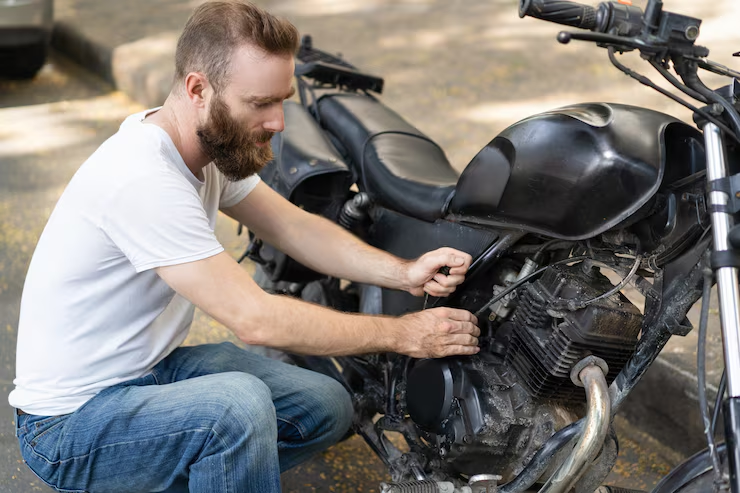
The Stranger Who Pulled Me from the Trash
The first thing I remember about Big Mike wasn’t his massive frame—though at six-foot-four with shoulders built like a wall, he was impossible to miss. It wasn’t even the beard that stretched down his chest or the faded military tattoos inked along his arms, telling stories he never spoke of. What I remember most was his voice at five in the morning, breaking the silence of my half-sleep inside a dumpster behind his motorcycle garage.
“You hungry, kid?”
I jolted awake, heart racing, ready to bolt. Three weeks on the streets had taught me one thing—when adults asked questions, trouble usually followed. Cops might drag me back to foster care, or worse, someone else might have darker intentions.
But Mike just stood there, holding a steaming cup of coffee in one hand and a sandwich in the other, staring at me like finding a fourteen-year-old sleeping in his trash was just another Tuesday.
“Come inside,” he said without waiting for a reply. “Too cold to be out here.”
Every instinct told me to run. But hunger, exhaustion, and fear had taken their toll. So I followed this giant of a man into Big Mike’s Custom Cycles—and into a new life I never saw coming.
A New Start
The shop smelled of oil, grease, and leather, with a faint trace of coffee in the air. Motorcycles, some whole and others in pieces, filled every inch of space. Tools hung neatly along the walls, arranged with military precision. A quiet radio hummed in the background—not blasting rock like I expected, but soft classical music that somehow felt calming.
Mike handed me the sandwich—turkey and cheese on fresh bread, miles better than the stale crusts I’d been digging out of his trash—and motioned to a stool.
“Eat,” he said simply.
And I did. I devoured that sandwich like it was the last food I’d ever see. Mike just watched, sipping his coffee, not asking the usual questions I wouldn’t have known how to answer anyway.
When I finished, he finally asked something that mattered: “You know how to hold a wrench?”
I shook my head, sure that was the end of it. He’d fed me, done his good deed.
“Want to learn?”
Those three words changed everything.
He didn’t ask my name. I later learned Mike never asked questions that might force someone to lie. He didn’t ask where I came from or why I’d been sleeping in his dumpster. He just handed me a socket wrench, showed me how to grip it, and put me to work helping rebuild a Harley engine.
We worked mostly in silence. Mike would occasionally explain something, correct my grip, or grunt in approval when I got it right. When the day ended, he handed me a twenty-dollar bill.
“Good job,” he said. “Shop opens at six tomorrow. You coming back?”
I clutched that twenty like it was treasure. “Thank you, sir.”
“Mike’s fine. ‘Sir’ makes me feel old.”
That night, I slept behind the shop again—but this time with a full belly and cash in my pocket. At sunrise, I found the back door unlocked. Inside was a cot, blanket, and pillow—clearly set up for me.
Mike was already there, drinking coffee. He looked up, nodded once, and went back to work. Neither of us mentioned the cot or the unlocked door. We just got to work.
The Crew
By noon, the other bikers started rolling in. I expected to be told to get lost, sure Mike hadn’t told them about the homeless kid in his storage room. But when a guy named Snake walked in—all leather, chains, and a scar cutting across his cheek—he just looked me over and grunted.
“You the new shop rat?”
I nodded.
“You eat yet?”
“I had coffee—”
“That’s not food.” He disappeared and returned twenty minutes later with enough Chinese takeout for three people. He sat down and ate with Mike and me like it was nothing unusual.
Next came Preacher—a lean man with gray in his beard and sharp, knowing eyes. He perched on a stool, pulled out an old paperback, and tossed it to me.
“Read for me, kid. Eyes ain’t what they used to be. I like company while I work.”
It was The Old Man and the Sea. I’d read it back in school, before everything went wrong. My reading was rusty, and I stumbled through it.
“Sound it out,” Preacher said calmly. “Take your time.”
So I read while he listened, correcting me here and there, asking what I thought the story meant. Only later did I realize he was teaching me again—how to think, analyze, and care about words.
Then Bear showed up—a mountain of a man who somehow made Mike look small. He dropped a grocery bag on the workbench.
“Wife said these don’t fit our boy anymore,” he said. “Maybe they’ll fit you.”
Inside were jeans, shirts, and a winter coat—all new, tags still attached.
“Thank you,” I said, voice shaking.
“Don’t mention it.” Bear’s tone was rough. “You helping Mike out here?”
“Yes, sir.”
“Good. He needs the help. Place is always a disaster.”
Mike snorted. “Place is perfect. You just don’t know where anything is.”
They bantered for hours while I worked quietly, trying not to cry. I couldn’t remember strangers ever being this kind.
The Rules of Home
Six months later, Mike finally asked the question I’d been dreading.
“You got somewhere else to be, kid?”
We were locking up for the night. I’d been living in the storage room for half a year, working every day, part of the shop but not officially part of anything.
“No, sir.”
He was quiet a long time before saying, “Then keep that room tidy. Health inspector doesn’t like clutter.”
Just like that, I had a home. Not legally, but truly.
And home came with rules.
Rule one: school. “Every man needs an education,” Mike said, flipping eggs on a hot plate. “Not up for debate.”
He drove me every morning on his Harley, dropping me off at middle school among kids in shiny SUVs. The stares didn’t faze him.
“Three o’clock,” he’d say. “Don’t make me come get you.”
Somehow, he made it work with the school. I had a desk, teachers who helped me catch up, and a counselor who never asked too much.
Rule two: work. “Every man should know a trade,” Mike said. “Something real. Something with your hands.”
So I learned everything—how to rebuild engines, weld, paint, and polish until chrome shone. Mike never accepted “good enough.” Only “do it right.”
Rule three: Sunday dinner. “Family eats together.”
And what a family. Thirty bikers crowding the clubhouse every Sunday, bringing food, teasing me about school, arguing over motorcycles and movies. It was loud, chaotic, and the most love I’d ever known.
The Push to Dream Bigger
One night, Mike found me reading over some of his business papers—contracts, supply invoices, legal stuff I barely understood.
“Didn’t mean to snoop,” I said quickly.
“Kid, you’re sharp,” he said instead. “Too sharp for just turning wrenches. You could be more.”
“There’s nothing wrong with being like you,” I said honestly.
He smiled and ruffled my hair. “Appreciate that. But you’ve got potential beyond this shop. We’ll make sure you use it.”
We turned out to mean the whole club. Snake paid for SAT prep classes. Preacher—who used to be an engineer—tutored me in math. Bear’s wife helped with college applications and fee waivers.
They all invested in me—not for payback, but because that’s what family does.
When my acceptance letter from State University arrived with a full scholarship, Mike threw a party. Forty bikers showed up to celebrate. Mike even cried—though he blamed the engine fumes.
“You’re gonna be something special,” he said, hugging me tight. “Always knew it.”
Drifting Apart
College was another world—kids with beach houses, rich parents, and plans for internships abroad. They’d ask about my family, and I’d dodge the truth.
“What do your parents do?”
“Blue-collar work.”
“Where are you from?”
“Small town.”
I stopped talking about Mike, about Sunday dinners and Harley rides. When someone asked why I wanted to study law, I said I wanted to help people—but I didn’t mention that I meant kids like me.
Mike visited twice that first year, riding eight hours each way. He’d hug me in front of my dorm, ignoring the curious stares.
“Doing okay?”
“Yeah. Classes are good.”
“You eating? You look thin.”
He’d slip me cash “for books,” and I’d pretend I didn’t need it.
By law school, the distance had grown. Surrounded by future lawyers with family connections, I hid my past. I even told classmates my parents were gone. It was easier.
Mike came to my graduation in a new suit and his old biker boots. My study group asked who he was.
“Family friend,” I said.
He heard. His eyes flickered—hurt hidden behind pride. He didn’t say a word, just hugged me and drove home. I told myself distance was part of growing up. That it was necessary.
I was wrong.
The Call That Broke Me
Three years into my law career, Mike called. I almost didn’t answer. We spoke rarely by then—me always “too busy.”
“Not for me,” he said, as he always did. “But the city’s trying to close the shop.”
My stomach dropped. “What? Why?”
“Developers want the land. City says we’re bringing down property values. Calling us a blight.”
Forty years. That shop had stood for forty years, saving lives like mine. And now they wanted to erase it.
“Hire a lawyer,” I said automatically. “Fight it.”
“Can’t afford one good enough,” he said softly. “Just thought you should know. In case you wanted to say goodbye before it’s gone.”
“I’ll look into it,” I murmured, meaning nothing. “See what I can find.”
“Appreciate it.”
We hung up, and I sat there in my glass office, surrounded by success that suddenly felt hollow. I told myself I’d make some calls, find someone to help. I told myself I’d visit soon.
But I didn’t.
When the Mask Cracked
It took Jenny, my paralegal, finding me in tears at my desk for me to finally admit the truth I’d been avoiding.
“What happened?” she asked, genuine concern in her eyes.
I handed her my phone. Snake had sent me a photo — the shop sealed with a “CONDEMNED” notice, and Mike sitting on the steps, his head bowed, looking every bit his sixty-eight years.
“That man raised me,” I said, the words slipping out before I could stop them. “I was fourteen, living behind his shop in a dumpster. He took me in, gave me food, a home, paid for my schooling, made me who I am. And now the city’s taking his shop, and I’ve done nothing to help — because I’m too afraid people will find out I’m just trailer trash who got lucky.”
Jenny’s look shifted — concern melting into quiet disappointment. “Then maybe you’re not the man I thought you were.”
She left, and I sat there in the silence of my own hypocrisy — realizing I’d worked so hard to bury my past that I’d buried the person who’d saved me, too.
I didn’t clear my calendar. I didn’t tell anyone. I just grabbed my keys, left the office, and drove five hours straight to that shop — still in my tailored suit, my polished shoes, my lawyer’s armor.
When I arrived, the clubhouse was packed. Thirty bikers — older now, some with gray hair and reading glasses — sat around a table, faces heavy with defeat. They were pooling money, counting wrinkled bills and spare change, trying to scrape enough for a lawyer to fight city hall.
“I’ll take the case,” I said from the doorway.
Every head turned. Mike lifted his gaze, his eyes red and tired, and I saw the instant he recognized me — even after all those years and all the distance I’d put between us.
“Can’t pay you what you’re worth, son,” he said quietly.
“You already did,” I said, my voice breaking. “Twenty-three years ago — when you didn’t call the cops on a dumpster kid.”
The Battle for Big Mike’s
The case was nothing like the ones I handled in corporate law. It was messy, personal, and brutal. The city had endless resources, political backing, and a story that painted Mike’s shop as a dangerous “biker gang base” threatening a growing neighborhood.
Their attorney, Diane Morrison — a sharp, confident woman in her fifties — barely glanced at me during our first hearing.
“Cute that they got themselves a real lawyer,” she told her assistant loud enough for me to hear. “Doesn’t matter. The city council’s already signed off on redevelopment. This is just procedure.”
I smiled and stayed silent. Let her underestimate me. Let her think I was just some do-gooder playing hero.
The city trotted out residents with complaints — noise, property values, “unsafe vibes.” They spoke of the bikers like they were a disease spreading through the community.
I took notes. Listened carefully. Then I started digging.
I found every person Mike had helped over the decades — far more than I ever realized. Former runaways turned teachers, doctors, social workers, mechanics, parents. All of them had one thing in common: they’d found hope at Big Mike’s Custom Cycles.
I found seniors he’d helped — scooters repaired for free, groceries carried up stairs, driveways shoveled every winter.
I found veterans who gathered at the shop for friendship, the AA meetings held after hours, the charity toy runs every Christmas.
I built a mountain of evidence — proving that while the city labeled them a menace, Mike and his crew had been the backbone of that neighborhood for forty years.
The Day in Court
The courtroom was full for the final hearing. On one side, the city’s polished officials. On the other, thirty leather-clad bikers sitting upright and unashamed.
Morrison made her argument look effortless — noise complaints, lowered property values, “incompatible business practices.”
“This isn’t discrimination,” she said smoothly. “It’s about community standards and public safety.”
Then I stood to present our case.
I began with the stories. Fifteen witnesses — all grown, successful, grateful.
Dr. Sarah Chen, once an abused teen Mike found sleeping behind his shop.
Marcus Webb, a teacher now, once thrown out for being gay.
Lisa Parks, a social worker who’d run from foster care just like I had.
Each told their version of the same truth:
“Mike Mitchell gave me a place to sleep, made me go to school, gave me a job. He saved my life.”
Morrison tried to twist it. “So Mr. Mitchell regularly took in minors off the street? Without involving the authorities?”
Dr. Chen’s voice didn’t waver. “Yes. Because the authorities failed us. Mike didn’t.”
Next came the elderly residents.
Mrs. Patterson, 83, whose husband’s wheelchair Mike had fixed for free for ten years.
Mr. Lee, 76, who said the bikers were the only ones who checked on him after his wife passed.
Then the veterans, the recovered addicts, the kids from the neighborhood. I presented receipts — charity donations, school scholarships, community service records. Even videos of Mike teaching kids how to fix bikes in the summer.
By the time I was done, the city’s “menace” narrative was falling apart.
But Morrison wasn’t finished. “Mr. Thompson,” she said, smiling coldly, “you admit to housing runaway children?”
“I admit,” Mike said evenly, “to giving scared kids food and safety.”
“Without notifying authorities? That’s kidnapping.”
“That’s kindness,” Mike replied softly. “You’d understand that if you’d ever been fourteen and alone.”
She pressed harder. “And where are those runaways now?”
I rose. “Objection—irrelevant.”
The judge, a stern woman named Patricia Reeves, tilted her head. “Overruled. He may answer.”
Mike’s eyes found mine. “One of them is standing right there, Your Honor. My son — not by blood, but by choice. He’s defending me today because I didn’t throw him away like the rest of the world did.”
Silence. Morrison stared at me, stunned.
“You?” she asked. “You were one of them?”
“I’m his son,” I said clearly. “And I’m proud of it.”
Judge Reeves looked at me, her tone softening. “Counselor Thompson, is that true?”
“It is. I was a kid with nothing — living in a dumpster, eating trash. Mike Mitchell took me in. He made me finish school, paid for my education, and believed I could be more. If that’s what the city calls a blight, then maybe it’s the city that’s broken.”
The Judgment
Judge Reeves called a recess. When she returned, her face gave nothing away.
“I’ve reviewed the evidence,” she began. “The city has proven that Big Mike’s Custom Cycles creates some noise and attracts a distinct crowd. But the defense has demonstrated overwhelming evidence that Mr. Mitchell’s shop has been a cornerstone of this community for four decades.”
She looked at Mike directly.
“Mr. Mitchell, what you’ve built is more than a business. It’s a refuge, a mentorship program, and a lifeline for countless people. You’ve served the public good in ways this court cannot ignore.”
Morrison straightened, expecting a “but.”
It never came.
“The city’s petition for condemnation is denied,” Judge Reeves declared. “Big Mike’s Custom Cycles will remain open.”
The room erupted. Thirty bikers cheering, laughing, crying. Mike pulled me into a hug that nearly crushed me.
“Proud of you, son,” he whispered. “Even when you were ashamed of me.”
“I was never ashamed,” I tried to say, but he just smiled.
“Sure you were. That’s okay. Kids outgrow where they came from. But you came back — and that’s what matters.”
Owning My Story
That night, the celebration could’ve broken every noise ordinance in the book. Food, music, laughter — the sound of family.
I stood up, my voice shaking. “I’ve spent years hiding where I came from,” I said. “Pretending being raised by bikers made me less. But the truth is, everything good in me came from here — from this man, from this shop.”
I looked at Mike. “I changed my name ten years ago — legally. It’s David Mitchell now. Because you’re my father in every way that counts.”
The roar that followed nearly lifted the roof. Mike’s eyes were wet, and for once, he didn’t pretend it was from engine fumes. He just hugged me again — the dumpster kid who finally stopped pretending.
Two Years Later
My life’s different now.
My office walls are lined with photos — the shop, the crew, Sunday dinners. The past I once hid is now what I’m proudest of.
Some colleagues respect me more for it. Others whisper behind my back. Doesn’t matter anymore.
Every Sunday, I ride down to the shop. Mike taught me himself — said it was time I learned properly. We still work side by side, hands covered in grease, classical music playing from that same old radio he’s always loved.
“Never be ashamed of what you like,” he told me. “Life’s too short for pretending.”
I wish I’d understood that sooner.
Sometimes kids still show up — scared, hungry, lost. Mike feeds them, gives them work, offers them a bed. And now, when they need legal help, I’m there too.
I do pro bono work for kids like I once was. My firm supports it for the PR, but I’d do it anyway — because Mike would’ve.
The Legacy Lives On
Mike’s seventy now. His hands tremble some days, his memory slips, but every morning at dawn, he opens the shop door and checks the dumpster — just in case another hungry kid is out there.
A few weeks ago, we found one. Sixteen, bruised, desperate, trying to steal from the till. Mike didn’t yell. Didn’t call the cops. He handed her a sandwich and a wrench.
“You know how to use that?”
She shook her head.
“Want to learn?”
Now she’s in school, living in the storage room, learning bike repair from Mike. We’re helping her get legally emancipated — and if that doesn’t work, we’ll find another way. Because that’s what family does.
Business is booming. After the trial, people started showing up to support Mike — not just for repairs, but to be part of something good. The neighborhood that once feared us now embraces us.
Snake still teaches math with engine sizes. Preacher makes kids read while he works. Bear’s wife still “donates” clothes that always seem to fit perfectly. Sunday dinners haven’t stopped — and neither has Mike’s mission.
Coming Full Circle
Yesterday, a lawyer from another firm called me.
“We’ve got a kid,” she said. “Fifteen. Smart, angry, bounced between foster homes. I thought of you.”
I met him today — Marcus. He looked at me with the same mix of fear and defiance I once had.
“Why do you care?” he asked. “You don’t know me.”
“No,” I said. “But someone once cared about me when I was just like you. Now it’s my turn.”
“What if I mess it up? What if I’m not worth it?”
“Then we’ll figure it out together. That’s what family’s for.”
I took him to the shop. Watched him walk in — tense at first — until Mike handed him a sandwich and a wrench.
“Want to learn?” he asked.
Marcus is staying in the storage room tonight. Tomorrow, he’ll ride to school on the back of Mike’s Harley. He doesn’t know it yet, but his life just changed.
The Heart of It All
I’m David Mitchell — a senior partner at one of the state’s top law firms. I’ve got the office, the reputation, the cases.
But I’m also that kid who slept in a dumpster. The boy who learned what family means from a biker with a kind heart and rough hands. The one who got a second chance and now spends his life giving them.
Mike isn’t my father by blood — but he’s the man who found me when the world threw me away. He believed I could be more, and because of that, I am.
There’s a new sign under the shop’s name now:
“Big Mike’s Custom Cycles — Second Chances Given Here. All Welcome.”
Because that’s what he’s always done — given second chances to people who never got a first one.
And that’s the legacy I carry forward — one broken soul at a time.
Because when someone saves your life, you spend the rest of it saving others.
That’s the lesson of Big Mike’s Custom Cycles.
That’s the truth I’ll never hide again.
Trending Right Now:
- My Mother-in-Law Tried On My Wedding Dress and Destroyed It — So I Made Her Regret It Publicly
- He Cheated. She Laughed. I Served Them Both a Slideshow of Karma
- “I Overheard My Husband and Our Neighbor’s Daughter — So I Came Up With a Plan She Never Saw Coming”
- He Couldn’t Move, But He Knew Something Was Wrong — So He Looked Up
- I Gave a Ride to a Homeless Man — The Next Morning, Black SUVs Surrounded My Home
- I Married My Former Teacher — But Our Wedding Night Revealed a Secret I Never Saw Coming


Leave a Comment