
Part 1: The Gift That Was Supposed to Impress
The wedding invitation arrived on creamy, gold-edged cardstock—the kind of envelope that whispered luxury before you even opened it. “Mr. and Mrs. Zachary Morrison request the honor of your presence at the wedding of Adam Christopher Morrison and Megan Elizabeth Sterling,” the script announced, each letter as polished as the couple themselves.
I ran my finger over the embossed print and felt that familiar mix of anticipation and mild dread. Weddings in the family always meant showmanship, expectations—and in this case, Megan.
Adam, Zach’s younger brother, had always been sweet. But Megan? She was another story entirely.
“What do you think?” Zach asked, scrolling through their registry. “Crystal vase? Monogrammed towels? A designer coffee machine?”
I glanced at the list. It read less like wedding essentials and more like a luxury magazine spread. Hand-blown wine glasses, a $400 espresso maker, linen sheets with an eye-watering thread count.
“Everything’s so cold,” I said, settling beside him on the couch. “It’s like they wandered around a luxury store pointing at things just to flex.”
“That’s Megan’s style,” Zach replied, carefully neutral. Diplomatic was his default when it came to his future sister-in-law.
Megan Sterling was flawless in that infuriating way that made you second-guess your entire life. Her hair? Perfect. Her wardrobe? Designer. Her smile? Polished and practiced. Every conversation with her felt like a performance review—subtle jabs hidden in questions wrapped in silk.
“How’s that cute little marketing job of yours?” she had asked me last Christmas—ignoring the fact that I’m a senior account manager at a top-tier firm.
She once called our home “charming” in that tone people reserve for fixer-uppers on house hunting shows. And yet, I kept trying. She was marrying into the family. I wanted peace.
So when it came time to choose a gift, I thought, what if we didn’t pick from the registry? What if we gave them something they’d actually remember?
“What do most couples want after a wedding but rarely get to do right?” I asked Zach.
He thought for a beat. “A honeymoon.”
Exactly.
Not just a voucher or some cash toward one—a full honeymoon experience, planned from start to finish. Flights, hotel, activities. The whole deal. It felt… meaningful. Something that would say, “We care.”
Over the next few weeks, I treated the planning like one of my biggest client campaigns. I combed through travel sites, read hundreds of reviews, stalked hotel photos. We settled on a boutique resort in the Bahamas—romantic, private, and not outrageously expensive but stunning in every way. Private beach dinners, couples massages, turquoise waters. A dream.
“I’m impressed,” Zach said when I showed him the itinerary. “They’re going to love this.”
I smiled, proud of our plan. The cost was just over $6,000—more than we’d ever spent on anyone’s gift, even more than our own vacation budget. But we’d both gotten work bonuses, and I was confident this would be worth it.
“They’ll remember this forever,” I told him.
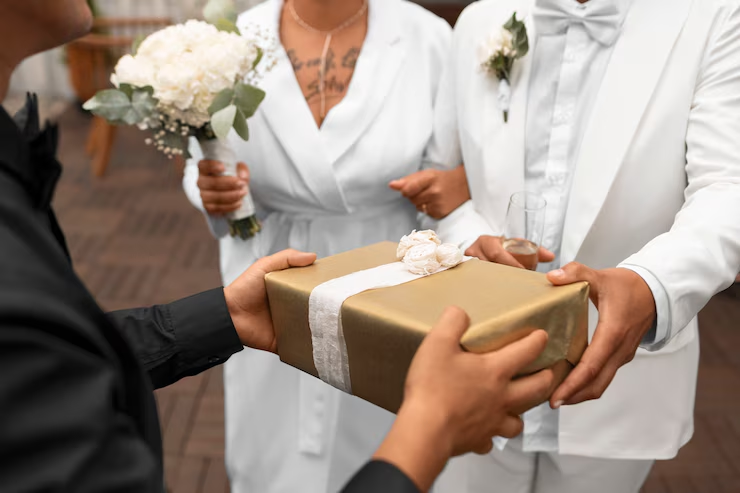
We presented it in a custom bamboo box with passport holders, printed itineraries in their wedding font, and even a “honeymoon survival kit” filled with essentials they’d never think to pack. Reef-safe sunscreen. Waterproof phone pouches. Romantic touches. And a handwritten note that came straight from the heart.
It felt like the perfect olive branch, the start of something warmer between Megan and me.
I could already picture the look on her face when she opened the box—surprise, maybe a rare, unguarded smile. Adam would be thrilled. Megan would be touched.
I thought this gift might finally shift the dynamic between us.
I thought it would mean something.
I had no idea how wrong I was.
Part 2: “Just This?”
The wedding venue looked like it had been plucked straight out of a Tuscan postcard and dropped into the hills of Southern California. The Fairmont Grand Del Mar wasn’t just elegant—it was obnoxiously perfect. Hand-painted tiles lined the entryway, manicured gardens hosted the cocktail hour, and everything—from the lighting to the linens—screamed “money.”
Megan had chosen blush pink, ivory, and gold as her wedding colors, coordinated with surgical precision. It was just soft enough to seem tasteful, but the luxury still smacked you in the face the second you stepped onto the property.
The ceremony took place under a garden pavilion wrapped in flowering vines, with olive trees casting long shadows in the golden light. A string quartet played softly as guests took their seats, and when Adam walked out in a designer tuxedo looking equal parts nervous and smitten, even I teared up a little.
Then Megan appeared.
The dress—easily worth more than my car—sparkled with every step. She was stunning, flawless, practically glowing. The kind of bride who’d been preparing for this entrance since she was old enough to spell “princess.”
Zach leaned toward me and whispered, “They look happy.”
And they did. Whatever else could be said about Megan, she clearly loved Adam. At least in that moment.
The reception that followed was held in a ballroom straight out of a dream—ceiling lights twinkled like stars above ivory-draped tables and towering blush rose centerpieces. Our gift sat elegantly among the wrapped boxes and designer-brand bags. I’d angled the bamboo box just so, hoping it would stand out—subtle, but curious enough to draw attention.
Dinner was fancy but genuinely delicious, and for once, I found myself enjoying the conversations around me. At our table were Adam’s college friends and their spouses—smart, funny people who asked about me, not just what I did.
“So, you do nonprofit marketing?” one woman named Sarah asked, genuinely interested. “That must be rewarding.”
I smiled. “It is. It’s not flashy work, but it feels good to help organizations tell their stories and actually make an impact.”
For the first time that evening, I let my guard down. No judgment. No side-eye. Just easy company and good wine.
After dinner, Megan and Adam danced to Etta James’s “At Last,” gliding across the floor with the confidence of people who’d clearly taken lessons. Watching them, I felt that little swell of hope again—maybe this gift would be a turning point. Maybe tonight, Megan would see we really wanted to welcome her.
Once the cake was cut and photos were winding down, Zach squeezed my hand.
“Should we give it to them now?”
I nodded and grabbed the bamboo box. This was it.
“Adam, Megan,” I said, stepping up to them near the cake table. “We wanted to give you something a little different—something personal.”
“Oh, how sweet!” Megan chirped, her public smile flawless as always. “You didn’t have to bring it here!”
“We wanted to,” Zach said.
I handed her the box, watching closely as she admired the smooth finish and custom ribbon.
“This is gorgeous,” she said. “You guys are always so thoughtful.”
She opened it, carefully lifting each layer of tissue paper until she found the brochure. Her eyes scanned the cover photo of turquoise water and white sand. Then the itinerary. The flight details. The activities. The ocean-view villa. A trip we’d designed from the heart.
But instead of the look of wonder or delight I’d envisioned… something shifted in her expression.
“Oh,” she said. “Just this?”
Time slowed.
“Just this?”
She held the itinerary up, her manicured fingers brushing the corner. “It’s lovely,” she said, “but I thought maybe… I don’t know. First class? Five-star resort? These flights are in economy.”
The silence around us was deafening. I felt heat creep up my neck. Megan wasn’t just underwhelmed—she was offended.
“We thought the experience would matter more than the airline seat,” I said, trying to keep my voice steady.
“I’m sure it’ll be fine,” Megan replied with a sugar-sweet tone. “It just doesn’t really match our usual travel standard. Adam and I typically stay at the Four Seasons when we travel. But this is… cute.”
That last word stung more than I expected. I wasn’t sure if she meant the gift or us.
Adam, to his credit, looked embarrassed. “It’s a beautiful gesture,” he said quickly. “Thank you.”
But the damage was done. People had heard. They’d seen the look on Megan’s face. The polite humiliation was public, pointed, and impossible to ignore.
I wanted to disappear.
The rest of the night passed in a blur. I smiled through it, danced with Zach, accepted compliments on my dress from strangers, and clapped during the bouquet toss—but inside, I was unraveling.
On the drive home, the silence between us was thick until I finally said, “Was I overreacting?”
Zach didn’t hesitate. “No. She was cruel. And completely out of line.”
I sighed. “Maybe we should’ve known it wouldn’t be good enough for her.”
“No, Brooke. That gift was generous, thoughtful, and filled with love. Megan’s reaction says more about her than about anything we did.”
We pulled into our driveway, and I suddenly remembered something.
“We didn’t pay for the trip yet, did we?”
Zach shook his head. “No. We have until next week.”
“Good.” I closed the car door slowly. “Because I think we should give it to someone who would actually appreciate it.”
Zach paused, turning to me under the porch light. “You’re serious?”
“Dead serious. Gifts should be received with grace. She made it clear she doesn’t want ours.”
“Okay. But this could stir things up.”
“Let it,” I said. “At least it won’t go to waste.”
And just like that, the weight started to lift.
I didn’t know who we’d give the honeymoon to yet—but I knew someone out there deserved it far more than the woman who turned her nose up at six thousand dollars of love and effort because it didn’t come wrapped in the lifestyle she expected.
And that? That made me sleep easier than I had in weeks.
Part 3: The Perfect Recipients
The idea had quietly taken root the night Megan dismissed our gift, but it blossomed into certainty that Sunday morning as I spotted Matthew and Lydia Williams seated quietly at the back of the church. They looked worn down—the kind of tired that seeps into your bones and stays there. You could see it in their eyes, in the way they leaned into each other not out of habit but survival.
Matthew worked grueling shifts as a paramedic, rarely clocking out on time. Lydia, a NICU nurse, spent her nights surrounded by fragile newborns and desperate prayers. They’d married in the church pastor’s office six months ago—no dress, no venue, just coffee and cake afterward in the fellowship hall. Not because they didn’t dream of something more, but because life hadn’t allowed it.
I watched them during the service—how they held hands during prayer, how they shared a hymnal even though others sat unused. Their connection was real. It wasn’t showy or choreographed. It was love that had been tested, proven, and strengthened. The complete opposite of the performative fairy tale I’d just witnessed at Megan’s wedding.
As people began to gather for fellowship after the service, Zach leaned toward me. “You’re thinking hard. What’s going on?”
I nodded toward the couple. “Them. When do you think they last had a vacation?”
He followed my gaze. “Maybe never. Why?”
“Because I think we just found the right people for that honeymoon trip.”
Zach blinked. “Matthew and Lydia? We hardly know them.”
“We know enough. We know they’re kind. We know they spend their lives taking care of others. And we know they’d be overwhelmed with joy to receive something Megan threw back in our faces.”
He was quiet for a moment, weighing family tension against what his heart knew was right. “Megan’s going to lose her mind.”
“She already made her opinion very clear. So let’s give it to people who’ll actually value it.”
After service, we approached them gently and led them to a quieter corner of the fellowship hall. They looked curious, but not uncomfortable.
“There’s something we want to offer you,” I began, handing over a folder containing everything—brochures, itineraries, booking details.
“We originally planned this as a wedding gift for my brother-in-law and his wife,” I explained. “But let’s just say… they didn’t exactly embrace it. We’d love to offer it to you two instead, as a belated wedding gift.”
Lydia’s eyes widened. “Is this a real trip?”
“To the Bahamas,” Zach confirmed. “Five days, all-inclusive. Flights, the resort, food, everything’s taken care of.”
Matthew immediately started shaking his head. “This must have cost a fortune. We can’t possibly accept this.”
“You can,” I insisted. “And we hope you will. It’s already paid for. All it needs is your names.”
Lydia’s hands trembled as she clutched the itinerary. “Are you serious?”
“As serious as you were when you took care of premature twins for 12 hours straight,” I smiled. “This is for you.”
Tears came fast. Lydia first, then Matthew. It was one of the most honest, grateful reactions I’ve ever witnessed.
“You deserve this,” I said, my voice catching. “Let someone take care of you for once.”
“But… what about your brother-in-law?” Matthew asked gently.
Zach and I exchanged a knowing look. “They didn’t want it. You do. That’s all that matters.”
The trip was easily transferred. Our travel agent barely blinked at the change. “Oh, it happens more than you’d think,” she chuckled. “And honestly, this couple sounds way more excited about it.”
Excited was an understatement. In the weeks leading up to their departure, Matthew and Lydia texted us photos of their new swimsuits, asked about excursion options, and called to share how nervous but thrilled they were.
“I’ve never snorkeled before,” Lydia said during one call. “What if I mess it up?”
“You won’t,” I promised. “You’ll be swimming with tropical fish like a pro.”
Meanwhile, Adam and Megan? Silence.
No calls. No questions. No mention of the trip at all.
Until two weeks after Matthew and Lydia returned home, glowing and still gushing over sunset dinners and dolphin swims. That’s when I got the text from Megan.
“Hey Brooke! Just realized we never got the details for the honeymoon trip you gifted us. Could you resend them? I want to start packing!”
I stared at the screen for a full minute. Was this real? Did she forget her dismissive comments? Or was she testing us, expecting that we’d upgraded the trip behind the scenes to something more “her standard”?
I showed it to Zach. He read it twice, then snorted. “She’s joking, right?”
“Nope. She’s serious.”
“How do you want to handle it?”
I could’ve ignored it. I could’ve sent photos of Matthew and Lydia drinking piña coladas on the beach. But in the end, I chose honesty—with a touch of restraint.
“Hey Megan! We actually gave that trip to another couple. Since you mentioned it didn’t meet your standards, we figured you’d prefer to plan something yourselves.”
The phone rang almost instantly.
“Brooke!” Megan shrieked. “What do you mean you gave it away? That was our wedding gift!”
“You turned it down, Megan. Publicly. You said it wasn’t your style.”
“I didn’t reject it! I just… expected you’d upgrade it!”
“To what, exactly?”
“To something worthy of us! Business class, a five-star resort—at least a suite!”
“So… you expected a better gift after insulting the one we gave you?”
“I expected you to understand what we deserve!”
Her entitlement was jaw-dropping. Somehow, she thought insulting a gift meant she should be rewarded with a better one.
“We gave that trip to a couple who actually appreciated it,” I said. “They were grateful. They deserved it.”
“Who? Who got our honeymoon?”
“Matthew and Lydia Williams.”
“You’re kidding me. You gave our honeymoon to a couple from church?”
“Yep. And they had an unforgettable time.”
There was a pause. Then: “This is about punishing me, isn’t it?”
“No. It’s about not wasting kindness on people who can’t recognize it.”
“I can’t believe you’d do this. Adam’s going to be furious.”
“Then Adam is welcome to call Zach.”
And I hung up.
Adam did call Zach that evening. But his tone wasn’t angry. It was resigned.
“I get it,” he said. “I’m not thrilled, but I get it. Megan… she has a way of saying things.”
Zach didn’t let him off easy. “It wasn’t just how she said it. It was what she meant. That trip was generous, and she tore it down in front of everyone.”
“I know. I’m sorry.”
“Megan needs to understand that words have consequences.”
“I’ll talk to her.”
When the call ended, I felt something I hadn’t felt in weeks—peace.
We’d taken a moment of humiliation and turned it into a blessing. We’d chosen kindness—but not the kind that enables bad behavior. The kind that says: our love is not for the ungrateful.
Sometimes the most powerful gift you can give isn’t a luxury vacation—it’s the refusal to be taken for granted.
Part 4: When Gratitude Isn’t Enough
The weeks after our conversation with Adam and Megan felt like a crash course in passive-aggressive drama. Since Megan couldn’t outright admit she’d dismissed a generous gift, she found other ways to let her displeasure simmer—loudly and publicly.
It started on social media. She began posting vague digs about “phony relatives” who “promise one thing and deliver another,” alongside photos of fine dining and luxury hotels with captions like “only accept what you’re truly worth.” She even shared articles preaching about “preserving standards in relationships.”
One evening, Zach held up his phone. “She just posted a quote: ‘True friends elevate your dreams instead of lowering your expectations.’”
Without looking up from my book, I replied, “She’s not wrong. True friends do elevate your dreams. They also say thank you when someone drops six grand on their honeymoon.”
“Does any of this bother you?” Zach asked.
“Her cryptic Facebook posts? After publicly embarrassing us at her wedding? Not really.”
And it was true. I had finally stopped caring whether Megan liked me or not. For two years, I’d tried to bridge the gap between us. Now I realized the issue wasn’t my approach—it was her attitude.
Eventually, the social media jabs escalated into storytelling. Megan started spinning a version of events that painted us as the villains—claiming we had promised a luxury honeymoon and “downgraded it last-minute.” She conveniently skipped the part where she’d rejected the gift and demanded upgrades.
“Mom called,” Zach said after a tense phone chat. “She asked why we changed our minds about Megan and Adam’s gift.”
“What did you tell her?”
“The truth. We gave them exactly what we planned. They refused it, so we gave it to people who valued it.”
“Let me guess—Megan told her we were sending them to Europe and swapped it to the Caribbean?”
“Bingo.”
It would’ve been maddening if it weren’t so predictable. Megan had always been the type to rewrite reality to make herself the victim when things didn’t go her way.
The real curveball came six weeks later when Adam called.
“Megan wants to clear the air,” he said. “She regrets the misunderstanding and wants to fix things.”
“Misunderstanding?” Zach asked cautiously.
“You know—the confusion around the trip. She thinks both sides could’ve communicated better.”
Zach and I debated whether to attend the barbecue invitation that followed. Ultimately, curiosity won.
Their new home was exactly what I expected—a designer showroom more than a place to live. Every surface was pristine, every item placed to impress.
“Come in! Let me show you around,” Megan said cheerfully, giving us a grand tour. It was clear the intent was to showcase status. “The kitchen is my favorite,” she said, stroking the marble counters. “All European appliances, completely custom.”
“It’s lovely,” I replied, though to me, it felt more showroom than sanctuary.
Adam and Megan’s guests were a mix of college friends and coworkers—all seemingly charmed by Megan’s carefully curated narrative. I overheard whispers about their “underwhelming” honeymoon and how they had to “make the best of it.”
“We ended up in Turks and Caicos,” Megan told a group by the pool. “It wasn’t our original plan, but we made it work. Sometimes others just… let you down.”
Zach overheard and clenched his jaw. In her story, we hadn’t gifted them anything—they’d been forced into settling.
Later, after guests left, Megan invited us for coffee to “talk.” We sat in her flawless living room, sipping from porcelain cups that probably never saw regular use.
“I just want to revisit the whole wedding gift thing,” she began in a diplomatic tone. “There was some miscommunication… and I think it’s important we clear that up.”
“What kind of miscommunication?” I asked.
“Well, when you gave us the trip details, I was just surprised. Based on our conversations, I expected something else.”
“What conversations?” I asked. “We never discussed your honeymoon plans.”
“Not directly, but Adam mentioned we were eyeing Europe. I figured you knew that.”
Zach and I exchanged a glance—this was news to both of us.
“Megan,” Zach said gently, “we never talked to Adam about your preferences. We picked a resort with glowing reviews that catered to couples.”
She shrugged. “It just didn’t feel like us. Economy flights, four-star resort… it felt like something you would enjoy, not us.”
“So you rejected it,” Zach said plainly.
“I didn’t reject it—I just voiced my concerns. I thought we could collaborate on something more fitting.”
“By ‘more fitting,’ you mean more expensive.”
“I mean something that matched our lifestyle. There’s nothing wrong with having standards.”
That was it. The gaslighting, the twisted version of events, the entitlement wrapped in politeness—I’d had enough.
“Megan,” I said, calmly placing my cup down, “we spent weeks planning that gift. We researched, compared options, and booked something special for you both. It cost us over six thousand dollars.”
“I know you spent money—”
“I’m not finished. At your wedding reception, in front of everyone, you looked at our gift and said, ‘Just this?’ You criticized the resort, the flights, everything. You made it clear you thought it wasn’t good enough.”
“I didn’t mean—”
“You were cruel. So, we gave that trip to people who would treasure it.”
“But it was our honeymoon!”
“No—it was our gift. One you dismissed. So we gave it to a couple who cried when they received it. They were overwhelmed with gratitude.”
“You’re making me sound awful!”
“I’m describing what happened. If that sounds awful, maybe ask yourself why.”
Finally, Adam broke his silence. “Megan… did you really say that at the reception?”
“I didn’t mean it like that. I was just surprised.”
“But you said it wasn’t good enough?”
“I said it wasn’t what I expected.”
“After my brother and sister-in-law spent thousands trying to do something thoughtful?”
For the first time ever, Megan looked genuinely remorseful.
“I didn’t realize… I thought you’d want to make it perfect.”
“Perfect for who?” I asked.
“For us. For our honeymoon.”
“Megan,” I said, “a perfect honeymoon is about memories, not marble and flight class. The couple we gifted the trip to? Matthew and Lydia Williams—they cried when we told them. That’s what appreciation looks like.”
“They cried?” she repeated quietly.
“Because it meant something to them. Because they saw the heart behind it.”
Silence lingered until Megan finally spoke. “I owe you both an apology. I was so focused on what I thought we deserved that I completely missed the kindness in what you offered.”
“We were trying to give you a beautiful start,” Zach said.
“And I made it ugly,” she replied.
“No—you turned it into a lesson,” I corrected.
“A lesson?”
“One about entitlement versus gratitude. And maybe, we taught you about the power of treating kindness with respect.”
Adam squeezed her hand. “We have to do better. This isn’t the way we treat family.”
“I know,” she whispered. “I don’t even know why I do it. Why I always want more.”
“Maybe,” I said gently, “you’ve confused having standards with being ungrateful. Wanting nice things is fine—but rejecting generosity? That’s something else.”
We left their house with an uneasy peace. Not reconciliation—but a clear boundary. We might not be friends, but we could coexist—without the judgment, without the masks.
Epilogue: What We Gave—and What We Gained
Six months later, a handwritten card arrived in our mailbox. It was from Matthew and Lydia—the couple who had gone on the trip. Tucked inside was a sunlit photo of them standing arm in arm on a beach in the Bahamas, beaming with joy.
Lydia’s words were heartfelt:
“That vacation did more than give us rest. It reminded us that people out there truly care. You didn’t just gift us a honeymoon—you gave us hope, warmth, and the feeling of belonging. We’ll never forget that.”
I pinned that photo to my corkboard at work. Not as a reminder of the drama we’d endured with Megan—but as proof of what genuine gratitude looks like. That moment stayed with me.
A year later, Adam and Megan shared that they were expecting their first child. At the baby shower, Megan pulled me aside. She looked different—not just pregnant, but softer somehow.
“I wanted to thank you again,” she said. “For what you taught me about gratitude.”
I raised an eyebrow, surprised.
“I’ve been reflecting a lot lately,” she continued. “About the kind of mother I want to be. And I’ve realized—I don’t want to raise a child who thinks they’re entitled to everything. I want them to understand the value of kindness. To say thank you when someone does something meaningful for them.”
I smiled. “That’s a beautiful goal.”
“I wouldn’t have gotten here without you,” she admitted.
“You got here on your own,” I replied gently. “I just offered a little perspective.”
When their baby girl arrived, they named her Grace. Maybe it was a coincidence. Maybe it wasn’t. But I like to think that our unexpected gift—given with heart, received with appreciation—played some part in that name.
Looking back, the lesson wasn’t about revenge. It wasn’t about teaching someone a lesson for being ungrateful. It was about understanding this simple truth: Generosity needs two sides—one willing to give, and one willing to receive with grace.
Sometimes, the most powerful gift you can offer someone is a chance to recognize the beauty in what they’re given. And sometimes, the most freeing gift you can give yourself is the permission to stop trying to win over people who never saw your value in the first place.
Matthew and Lydia still send us Christmas cards. Their family is growing, and they make it a mission to pass on that same kindness to others. They never forgot how it felt to be seen, to be given something meaningful without asking.
Megan eventually learned how to say “thank you” with sincerity. Adam learned the difference between support and blind defense.
And Zach and I? We learned that generosity isn’t about price tags or praise—it’s about impact.
The bamboo gift box now sits tucked away in our closet. Not as a memory of what went wrong, but as a symbol of what went right—and a reminder that the most precious gifts are the ones shared with those who truly understand their worth.
Some presents come with ribbons. Others come wrapped in hard-earned lessons. But the best gifts? They come with the quiet assurance that they’re going to someone who will receive them with the grace they deserve.
THE END
This story delves into the tension between entitlement and gratitude, highlighting the fine line between generosity and enabling. It explores how differing values and expectations can complicate family relationships, and underscores the importance of setting healthy boundaries—even with loved ones. At its core, the story reveals that true appreciation isn’t measured by the price tag of a gift, but by the recognition of the thought, care, and love behind it. It’s a powerful reminder to share your generosity with those who value it, and that sometimes the most meaningful lesson is learning the difference between having high standards—and being simply ungrateful.


Leave a Comment