
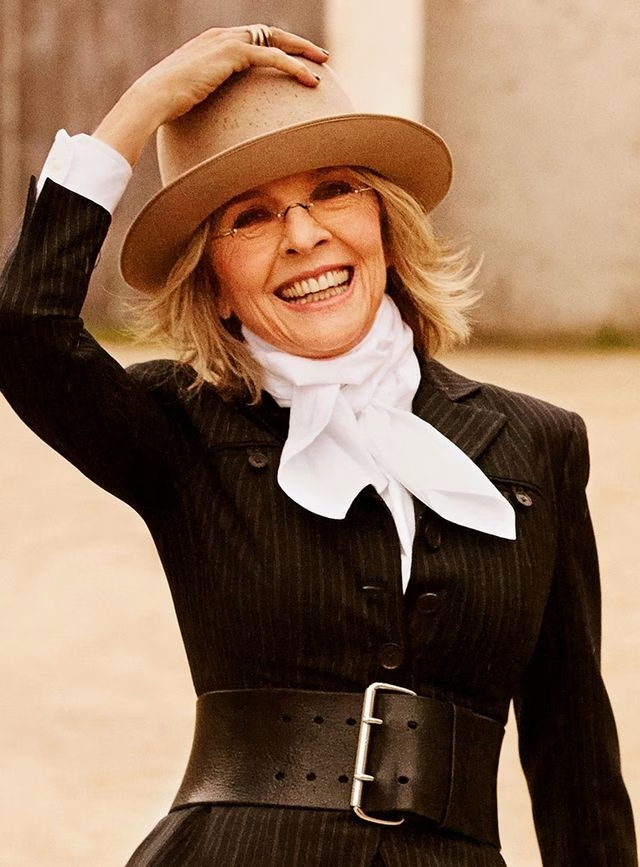
Diane Keaton: Embracing the Unscripted Final Act of a True Original
For over fifty years, Diane Keaton was the one woman who consistently defied easy definition. She was a living paradox—at once refined yet delightfully quirky, deeply thoughtful yet wonderfully comedic, fiercely guarded in her privacy yet profoundly relatable to millions. Her iconic characters frequently navigated love, life, and identity with an endearing awkwardness, but through their journeys, Keaton taught generations that imperfection wasn’t a fault; it was a distinctive form of artistry.
As her long, vibrant career approached its close, Keaton quietly slipped away from the bright studio lights and major public events that had once dominated her existence. Those closest to her shared that she found solace in the calmer rhythm of her final months—a routine centered not on premieres or cameras, but on deep creativity, cherished companionship, and tranquility. It was, as a long-time friend put it, “Diane choosing to pen her final scene—not with fanfare or applause, but with immense dignity.”
A Measured Farewell
Keaton’s residence in Los Angeles was always more of a peaceful sanctuary than a celebrity showcase. Designed in her favored Spanish Colonial style, it was filled with art, stacks of books, classic black-and-white photos, and the happy sounds of family. In those concluding months, she spent much of her time sitting in the back garden, watching the sunlight streak through the olive trees, her Golden Retriever, Reggie, resting loyally nearby. She continued to wear her famous wide-brimmed hats, drank her morning coffee from the same large mug, and always found a way to smile at life’s little absurdities.
“She never sought sympathy,” recounted a friend who visited regularly. “If she felt sad, she’d turn it into a joke. If she felt nostalgic, she’d tell a story that made everyone laugh through their tears. Diane simply wouldn’t allow grief to define her—only wit and warmth would.”
She embraced her quiet time. Neighbors sometimes spotted her on early morning walks with Reggie, bundled up in one of her signature oversized coats, offering a sincere, warm smile to everyone she met. Occasionally, she’d softly hum to herself—a tune from a vintage film or maybe a melody of her own making. Her pace of life had slowed, but her lively spirit remained undiminished.
Hollywood Mourns an Irreplaceable Icon
When the news broke that Diane Keaton had passed away at 79, the world paused. This was more than the loss of an actress—it marked the end of an incomparable era. Tributes poured in across social media platforms, television shows, and industry events. Directors, former co-stars, and countless fans struggled to articulate what made her so unique.
Meryl Streep publicly referred to her as “a walking verse of poetry.” Al Pacino remembered her as “my best scene partner and a person I loved dearly.” From new indie filmmakers to Hollywood’s most seasoned veterans, there was a universal understanding: Diane Keaton could never be replaced.
Her final Instagram post, dated April 11, now serves as an unintended farewell. In the photo, she is smiling next to Reggie, bathed in sunlight, holding a bag of dog treats from her home design partnership. The caption, a perfect example of Keaton’s humor, read: “Proof our pets have great taste too!”
Fans, unaware this would be her last public message, initially flooded the comments with lighthearted affection. After her death, those same comments became messages of sorrow and remembrance. “Thank you for everything, Diane,” one fan wrote. “You made being quirky look like a wonderful thing.”
A Private Existence, Passionately Lived
Throughout her career, Keaton skillfully maintained a delicate division between her famous public self and her actual private life. Fame had never completely captured her; in fact, she deliberately kept it at a distance. Despite her immense stardom, she carried no celebrity arrogance. She cooked her own food, loved hunting for treasures at thrift stores, and spent hours photographing light patterns, old buildings, and trees. She frequently stated that she found more genuine satisfaction in restoring homes than attending Hollywood parties.
During her final months, she spoke often of gratitude. Friends remember her feeling lucky to have experienced a rich creative life, one that allowed her to act, write, design, and sing. She continued to jot down notes for unfinished creative projects—ideas for essays, film concepts, or perhaps another book. “She was incapable of stopping the creative process,” a friend noted. “Even when she was too tired to act, she would sketch, write, or hum. That was Diane—always building something new out of quiet, reflective moments.”
Her evenings were simple: a dog by her side, a glass of wine, and sometimes an old black-and-white movie on the screen. In many ways, she was still the same young woman who had moved to New York City decades ago with a heart full of dreams and a nervous kind of courage.
The Dream She Finally Achieved
Few people realized that Diane Keaton had quietly accomplished one of her oldest personal goals before she passed: she had become a professional recording artist. Her 2024 holiday single, “First Christmas,” may have seemed like a playful whim to outsiders, but for her, it was a profound personal triumph. The song itself, tender and full of nostalgia, was both an ode to treasured memories and an affirmation of life’s joy.
“I had always wanted to sing,” she once admitted in an interview. “But I was terrified of failing at it. So I waited… until I simply stopped caring about the possibility of failure.”
When she announced the single on Instagram, her excitement was infectious: “I CAN’T BELIEVE IT’S FINALLY HERE! MY DEBUT HOLIDAY SINGLE ‘FIRST CHRISTMAS’ IS COMING OUT FRIDAY, NOVEMBER 29TH. SO EXCITED TO SHARE THIS SONG WITH YOU ALL.”
Her voice on the track was not technically flawless—it occasionally wavered, cracking slightly at the high notes—but this very quality made it beautiful. It was raw, honest, and distinctly Keaton. Listeners compared it to “hearing your own mother read a bedtime story after a glass of wine—funny, soft, and deeply moving.”
The song was far more than a career milestone. It was her gentle, poignant way of reminding the world that it is truly never too late to pursue a lifelong dream.
The Day Hollywood Lost Its Heart
On the morning of October 11, 2025, emergency services were called to Diane Keaton’s residence in Los Angeles. Despite the strenuous efforts of the responders, she could not be revived. She was formally pronounced dead later that morning. Her family, heartbroken, released a concise statement requesting privacy and asking fans to “celebrate the joy she left, not her absence.”
No official cause of death was released, and in characteristic Keaton fashion, she had left behind no grand public final requests—only quiet hopes that her body of work, rather than the details of her death, would be her lasting memory.
Her long-time friend and collaborator, Nancy Meyers, later posted an online message that read: “She wouldn’t want tears. She’d want laughter. She’d want us to remember the joy she brought into the world.”
And that is exactly the spirit the world attempted to honor.
Redefining the Hollywood Woman
To grasp Diane Keaton’s vast legacy is to understand how she fundamentally transformed the expectation of what a woman in Hollywood could be. When she took the role of Kay Adams in The Godfather (1972), audiences witnessed a young woman torn between moral lines and pure love, immense vulnerability and unexpected strength. Yet, it was her role in Annie Hall (1977) that would define her career forever.
In that movie, she was less acting and more embodying a persona. Her clumsy charm, her spontaneously joyful laughter, her notoriously mismatched clothing—it was all authentically her. The film’s director and writer, Woody Allen, once famously remarked, “Annie Hall wasn’t a character. She was Diane.” This ability to fuse the role and the reality was perhaps the source of her brilliance.
Keaton’s performance secured her the Academy Award for Best Actress and cemented her status as a cultural icon. More significantly, she redefined how women could exist on screen. She was weird without apology. She made nervous uncertainty look captivating. She made intelligence highly attractive. She even made neurosis appear fashionable.
Her personal fashion—men’s neckties, baggy vests, and slouchy trousers—sparked a global fashion revolution. Designers still cite “the Keaton look” decades later. She proved that femininity wasn’t about adhering to tight dresses or forced smiles; it was about authenticity, individual style, confidence, and soul.
An Artist Beyond Acting
But Diane Keaton was never limited to the role of an actress. She was a prolific photographer, memoirist, producer, and acclaimed interior designer. Her deep passion for architecture led her to restore numerous historic homes throughout California, carefully transforming them into warm, habitable spaces that felt like curated art galleries steeped in memory.
Her published works—Then Again and Let’s Just Say It Wasn’t Pretty—provided readers with a rare glimpse into her mind: thoughtful, disarmingly self-deprecating, and perpetually curious. She wrote not as a celebrity dispensing wisdom but as a woman genuinely attempting to understand herself. “I never completely figured life out,” she wrote. “I just lived it. And that’s probably the entire point.”
Her love for her family was equally central to her identity. She never married, but she frequently stated it wasn’t necessary. She adopted two children, Dexter and Duke, in her fifties, calling them “the single greatest achievement of my life.” She became the type of mother who injected humor and a sense of easy imperfection into every conversation, reminding the world that love, not formal structure, is what truly defines a family.
The Essence of a True Original
Following her death, heartfelt tributes continued to arrive from every corner of the entertainment world. Co-stars fondly recalled her warmth. Directors praised her professional fearlessness. Younger actors claimed her as their creative blueprint. But perhaps the most profound words came from her countless admirers—ordinary people who felt truly seen by her.
“Diane Keaton made me feel perfectly fine about being a misfit,” one fan commented. “She made awkwardness cool. She made being different feel like true freedom.”
Indeed, this might be her most powerful legacy. In a world relentlessly chasing perfection, Diane Keaton demonstrated that authenticity is a revolutionary force. She was not glamorous in the traditional Hollywood sense; she was breathtakingly human. She never played the established Hollywood game—she wrote her own rules entirely.
Finding the Final Serenity
Those closest to Keaton confirmed her final days were characterized by peace, even happiness. She continued her habitual morning walks with Reggie, frequently stopping to chat with neighbors or admire the seasonal changes. She laughed readily, continued to joke about the challenges of aging, and still insisted on wearing her cherished hats even indoors.
There was an unmistakable sense of serenity about her—a quiet, graceful acceptance that comes only from a life lived without regret. “She wasn’t afraid of the end,” a family friend shared. “She simply wanted to make sure she had communicated everything she needed to say—and she accomplished that, through every smile, every film, every book.”
In her home office, notebooks were found filled with various handwritten thoughts—future project concepts, cherished quotes, new song lyrics, and simple sketches. One page contained a single, carefully written line:
“The best thing you can be is yourself. The second-best thing is to never stop trying to be.”
A Legacy That Will Endure
Diane Keaton’s passing does not conclude her story—it simply marks a point of transformation. Her distinct spirit lives on in the countless individuals she inspired to embrace their quirks, their inner courage, and their personal truth. Every time someone dons a wide-brimmed hat, laughs spontaneously, or finds beauty in the mundane, a piece of Diane’s unique essence continues to exist.
Her films remain timeless, her cultural influence is immeasurable, and her memory is unforgettable. She once stated, “I don’t want people to remember me as perfect. I want to be remembered as someone who loved life, including all of its ridiculous parts.”
And that is precisely how the world will remember her.
May she find eternal peace—forever Hollywood’s fearless original, the remarkable woman who taught us that being yourself is not only enough, it is truly everything.
Trending Right Now:
- My Mother-in-Law Tried On My Wedding Dress and Destroyed It — So I Made Her Regret It Publicly
- He Cheated. She Laughed. I Served Them Both a Slideshow of Karma
- “I Overheard My Husband and Our Neighbor’s Daughter — So I Came Up With a Plan She Never Saw Coming”
- He Couldn’t Move, But He Knew Something Was Wrong — So He Looked Up
- I Gave a Ride to a Homeless Man — The Next Morning, Black SUVs Surrounded My Home
- I Married My Former Teacher — But Our Wedding Night Revealed a Secret I Never Saw Coming



Leave a Comment