
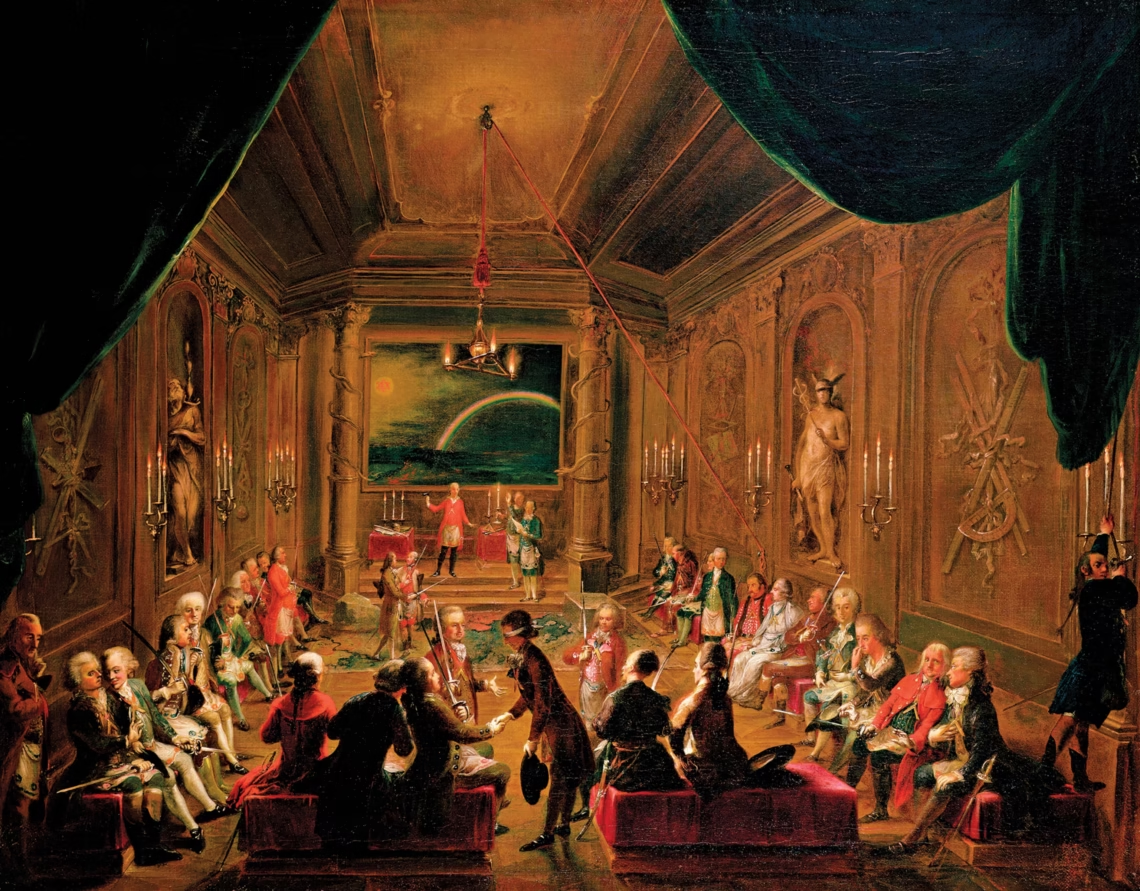
Genuine secret societies have existed for centuries, often conducting their affairs in hidden chambers and, frequently, wielding a mysterious influence on global culture. Throughout history, there have been countless secret organizations and related conspiracy theories. From political groups to college fraternities, these bodies mandate that their members conceal their activities, and sometimes their very identities, from the public eye. Step behind closed doors as we explore the 10 most influential secret societies in history.
1. The Order of the Oriental Temple (Ordo Templi Orientis)
The Ordo Templi Orientis (OTO) is a mystical organization that originated in the early twentieth century. Structured similarly to the more public Freemasons, the group reportedly uses ritual and occult practices as a way for members to ascend through various levels of prestige within the organization. The core philosophy of the OTO centered on belief in new age esoteric principles and practices as a path to realizing one’s true self. Famed occultist and notorious eccentric Aleister Crowley authored much of the group’s teachings, including a guiding document called the Mysteria Mystica Maxima, and he eventually became its head. Following his death, the influence and popularity of the OTO began to diminish, though it still operates today with various chapters distributed globally, primarily in the United States, the U.K., and other parts of Europe. As Aleister Crowley’s stature as a new age figure continues to grow, more of the OTO’s teachings have become public. Consequently, the group makes a much smaller effort to maintain secrecy today than it did historically. This does not mean they have abandoned all peculiar practices. Chief among these is the group’s fascination with sexuality, particularly their teachings on the “adoration of the phallus” and the magic of masturbation.
2. The Bilderberg Gathering
Though not strictly a secret society, the Bilderberg Group operates under a comparable shroud of mystery, which has made it the focus of countless conspiracy theories and critiques. Established in 1954, the group has held an exclusive, annual, invitation-only conference for various world leaders, chief executive officers, and media titans ever since. Initially formed to counter a surge of anti-American sentiment across Europe after WWII, the group appears to have evolved over the years into a broader forum for discussing mutual cultural understanding. The Bilderberg Group is controversial for one main reason: no press is permitted inside the conference, and no significant details concerning the topics discussed are ever officially released to the public. This level of secrecy, combined with the extreme security at the meeting sites—which often involve armed guards, police presence, and even fighter jets patrolling the airspace—has generated numerous conspiracy theories. The most popular claim is that the group attempts to manipulate the direction of public policy, financial markets, and media toward prescribed goals of their choosing, possibly even with the ultimate aim of establishing a “one world government.” The group dismisses these claims, stating that their primary objectives are fostering global understanding and preventing nuclear proliferation.
3. The Modern Knights Templar
The Knights Templar (full title: The United Religious, Military and Masonic Orders of the Temple and of St John of Jerusalem, Palestine, Rhodes and Malta) is a contemporary offshoot of Masonry and possesses no direct lineage to the original Knights Templar—a religious military order formed in the 12th century. Members of the Masonic Knights Templar do not claim a direct link to the medieval order but merely adopt some of its concepts and symbolism. To become a member of this group, one must already be a Christian Master Mason. This organization is separate and distinct; it is not simply a higher degree within Masonry. Despite the general disclaimer by Freemasonry that no Masonic group claims direct heritage from the medieval Knights Templar, certain degrees and orders are clearly modeled after the ancient Order. These are best described as “commemorative orders” or degrees. Nevertheless, despite the fraternity’s official denial, some Masons, non-Masons, and even anti-Masons still insist that certain Masonic rites or degrees were originally influenced directly by the Templars.
4. The Order of the Gilded Dawn (Ordo Aurorae Aureae)
The Order of the Golden Dawn was founded by Dr. William Robert Woodman, William Wynn Westcott, and Samuel Liddell MacGregor Mathers. All three were Freemasons and members of the Societas Rosicruciana in Anglia (an organization with Masonic affiliations). It is widely regarded as a precursor to the Ordo Templi Orientis and many other modern Occult organizations. The Golden Dawn’s belief system is largely derived from Christian mysticism, Qabalah, Hermeticism, Ancient Egyptian religion, Freemasonry, Alchemy, Theosophy, Magic, and Renaissance literature. William Yeats and Aleister Crowley are two of the group’s more well-known historical members. The core documents of the order are known as the Cipher Manuscripts. These were translated into English using a cipher attributed to Johannes Trithemius. The manuscripts consist of 60 pages detailing magical rituals. The basic structure of many of these rituals appears to stem from Rosicrucianism. There is considerable debate and controversy surrounding the origins of these documents.
5. The Black Hand (Crna Ruka)
The Black Hand was a clandestine society of anti-imperialist political revolutionaries founded in Serbia in 1912. It emerged as a splinter group from Narodna Odbrana, an organization striving to unify all Slavic people in Europe into a single nation. Achieving this required separation from the monarchy of Austria-Hungary, which had annexed Serbia some years prior. With this objective, the group began distributing anti-Austrian propaganda and training saboteurs and assassins to undermine political control within the province. Their strategy was to provoke a conflict between Serbia and Austria, which would give them an opportunity to liberate their country and unite the various Slavic nations. The Black Hand would be largely forgotten today were it not for their unforeseen involvement in one of the most pivotal events of the twentieth century. In 1914, the group orchestrated the assassination of Austrian Archduke Franz Ferdinand. The operation was severely mismanaged and only completed when a minor figure named Gavrilo Princip accidentally encountered the Archduke’s car and shot him at point-blank range (see photo). Despite the blunder, the consequences of the assassination were devastating. Within days, Austria-Hungary declared war on Serbia, and after the allies of both countries entered the conflict, the small dispute tragically escalated into World War I. The aftermath of WWI eventually led to WWII, which in turn led to the Cold War, cementing the Black Hand as one of the most bizarrely influential forces of the twentieth century.
6. The Hashshashin (Nizari Assassins)
The Hashshashin, or Nizari, were a secretive group of Muslim assassins active in the Middle East during the 13th century. The group was composed of Shia Muslims who separated from a larger sect and came together to establish a utopian Shi’ite state. Due to their small numbers, the group employed guerrilla tactics against their adversaries, including espionage, sabotage, and, most famously, political assassination. The Hashshashin would embed highly trained agents inside enemy fortresses, with instructions to strike only when the timing was perfect. They were noted for their extreme care in minimizing civilian casualties, as well as their skill in using stealth to intimidate their targets. Legend holds that enemy leaders would frequently awaken to find a Hashshashin dagger placed on their pillow, accompanied by a note declaring, “you are in our grasp.” Their reputation quickly grew, and before the Mongols finally destroyed the group, they became renowned contract killers, supposedly carrying out assignments for figures like King Richard the Lionheart. Around the time of their demise, the library holding all Nizari records was destroyed, so much of what is known about them today has passed into mythology. The most contentious legend revolves around the group’s use of drugs and intoxicants—”Hashshashin” roughly translates to “Hashish user“—which some have claimed were employed by members in combat. This idea has been largely debunked, but the term “Hashshashin” referring to the Nizari is widely believed to be the origin of the modern word “assassin.”
7. The Golden Circle Order
The Knights of the Golden Circle was a secret organization that thrived in the U.S. during the American Civil War. Initially, the group aimed to promote the annexation of Mexico and the West Indies, believing this would help the declining slave trade to prosper once again. However, once the Civil War began, the group shifted its focus from colonialism to staunch support of the newly formed Confederate government. The Knights soon amassed thousands of followers, many of whom formed guerrilla armies and began attacking Union strongholds in the West. In the Northern states, the enigmatic order had an even greater impact. Many newspapers and public figures engaged in sensational accusations, naming presumed Southern sympathizers, including President Franklin Pierce, as members of the Knights of the Golden Circle. Unlike most secret societies, the Golden Circle didn’t limit itself to clandestine meetings and mysterious schemes. Instead, the group frequently formed rogue armies and bands of bushwhackers to advance their agenda through force. In 1860, a group of the Knights attempted a failed invasion of Mexico. During the war, they robbed stagecoaches, tried to blockade the harbor in San Francisco, and a faction even briefly seized control of southern New Mexico.
8. The Order of Skull and Bones
The Order of Skull and Bones, a society at Yale University, was originally known as the Brotherhood of Death. It stands as one of the oldest student secret societies in the United States. Established in 1832, membership is reserved for an elite few. To this day, the society incorporates masonic-inspired rituals. Members gather every Thursday and Sunday in a structure they call the “Tomb.” According to Judy Schiff, Chief Archivist at the Yale University Library, the names of the members were only made public starting in the 1970s, but the rituals have always remained secret. Both Bush presidents were members of the society during their time at Yale, and numerous other members have achieved great fame and fortune. The society is the subject of many conspiracy theories; the most widespread is likely the belief that the CIA was founded by members of the group. The CIA released a statement in 2007 (coinciding with the popularity of the film The Good Shepherd) denying that the group served as an incubator for the agency.
9. The Freemasons
The Grand Masonic Lodge was formed in 1717 when four smaller groups of lodges merged. Membership levels initially consisted of the first and second degrees, but this was expanded in the 1750s to include the third degree, which led to a division within the group. A person who achieves the third degree is known as a Master Mason. Masons conduct their regular meetings in a highly ritualized manner. This includes frequent references to architectural symbols such as the compass and the square. They refer to God as “The Great Architect of the Universe.” The three primary degrees of Masonry are: 1: Entered Apprentice, making one a basic member. 2: Fellow Craft, an intermediate degree meant for developing deeper Masonic knowledge. 3: Master Mason, this degree is required to participate in most Masonic activities. Some rites (like the Scottish Rite) list up to 33 degrees of membership. Masons use signs and handshakes to gain entry to their meetings and to identify themselves to other Masons. These signs and handshakes often vary between jurisdictions and are periodically changed or updated. This is done to prevent unauthorized individuals from gaining access under false pretenses. Masons also wear distinctive clothing based on the attire of medieval stonemasons. The most recognizable item is the apron. To become a Mason, one generally needs to be recommended by a current member. In some instances, a person must be recommended three times before being accepted. Candidates must be at least 18 years old and of sound mind. Many religious organizations disapprove of Masonic membership, and the Roman Catholic Church strictly forbids Catholics from joining under threat of excommunication.
10. The Enlightened Ones (The Illuminati)
A movement of freethinkers that constituted the most radical faction of The Enlightenment—whose followers were called the Illuminati (though they referred to themselves as “Perfectibilists”)—was established on May 1, 1776, in Ingolstadt (Upper Bavaria), by the Jesuit-educated Adam Weishaupt. This group is now known as the Bavarian Illuminati. Although it was not legally permitted to operate, many influential intellectuals and progressive politicians were counted among its members. Even though some known Freemasons were part of the group, it was not officially endorsed by Masonry. The fact that the Illuminati did not require belief in a supreme being made them especially popular among atheists. This, combined with the fact that most members were humanists, is the reason for the widespread belief that the Illuminati seeks to overthrow organized religion. Internal disputes over leadership succession and government efforts to outlaw the group led to its complete collapse in the late 1700s. Despite this fact, conspiracy theorists like David Icke and Was Penre have argued that the Bavarian Illuminati survived, possibly even to the present day, though very little reliable evidence exists to support the idea that Weishaupt’s group continued into the 19th century. It has even been suggested that the Skull and Bones society is an American chapter of the Illuminati. Many people believe that the Illuminati is still active and secretly directing the main actions of world governments. It is widely speculated that their ultimate goal is to establish a One World Government founded on humanist and atheist principles.
Trending Right Now:
- My Mother-in-Law Tried On My Wedding Dress and Destroyed It — So I Made Her Regret It Publicly
- He Cheated. She Laughed. I Served Them Both a Slideshow of Karma
- “I Overheard My Husband and Our Neighbor’s Daughter — So I Came Up With a Plan She Never Saw Coming”
- He Couldn’t Move, But He Knew Something Was Wrong — So He Looked Up
- I Gave a Ride to a Homeless Man — The Next Morning, Black SUVs Surrounded My Home
- I Married My Former Teacher — But Our Wedding Night Revealed a Secret I Never Saw Coming


Leave a Comment